
Winning the highest office in Colorado didn’t guarantee a home for the victor, and most times meant house hunting after the election night celebrations were over.
Housing wasn’t a massive concern for most of the prominent figures who entered the Governor’s office. The executive residence of Colorado changed with every election. Many of the houses varied as much as the men who held the reins of the executive office.
Some homes are long gone, including Adams’s, whose house was located on 14th and Welton, and that of Governor Charles Thomas, who lived in a home on 16th and Sherman. A few homes remain, like Governor Kramer’s house on 11th and Logan. Other governors opted to live in a hotel during their time in office.

There was an undercurrent of support to find a permanent residence for the Governor. Many felt that it would be an essential status symbol to welcome dignitaries and business leaders, thereby attracting them to bolster Colorado’s economy.
The editorial pages of the Rocky Mountain News weren’t a stranger to those making the case for an executive mansion, such as on Jan. 9, 1953, when its Editor, Robert L. Chase, promoted the reasons why the state should fund an executive residence.
It would be helpful for a Colorado Governor to have a stately home to entertain guests and dignitaries.
“I believe it would be a good thing for Colorado if we had some state social functions of importance,” Chase wrote.
He noted that several surrounding states had a Governor’s residence and that several state employees had
“We provide homes for the warden of the State Penitentiary and for the heads of educational institutions. We have been even a little open-handed in some these cases.
But the governor — the man called upon to represent the entire state — must fend for himself. “
In 1955, a study was planned to design a “Governor’s Penthouse” atop a state office building on East Colfax and Sherman Street. The effort called for building the penthouse on top of the 7-story building.
Two of the state’s noted architects, G. Meredith Musick and Temple Buell, stated that there would be no technical issue designing a penthouse. Still, it would cost the state $750,000 ($9.1 million in 2025), and in their words, “could not secure the seclusion and dignity usually associated with appropriate residences for governors of any state.
A Colorado-Grown Solution
The Boettcher mansion was on Edith Eudora Kohl’s list of historic places to know around town for newcomers. The series, which spanned from 1948 to 1949, was later compiled into a book.

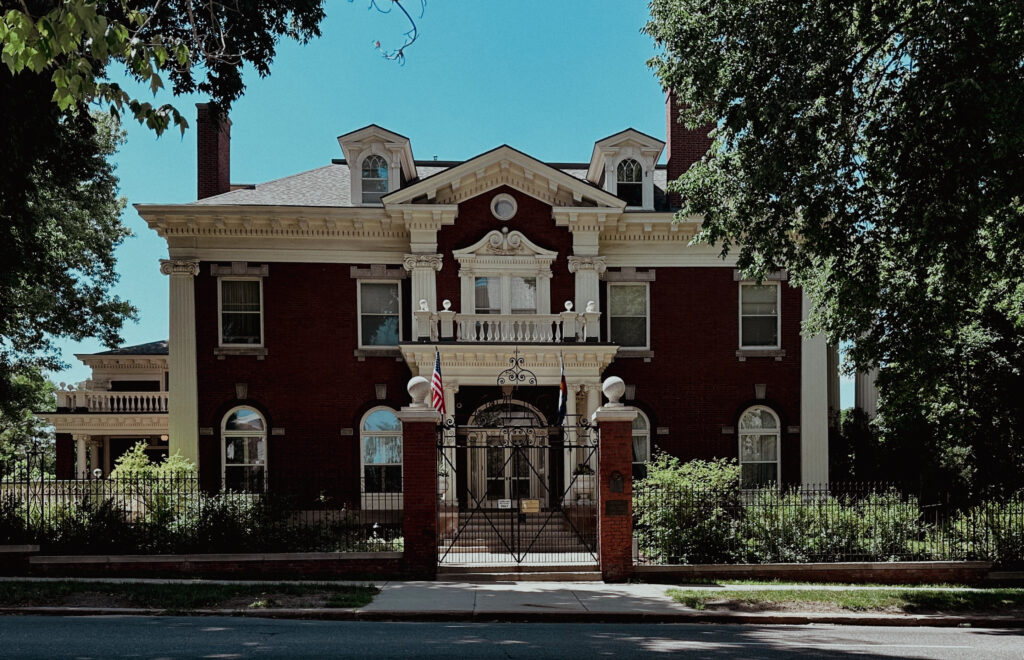
At the time, the mansion was home to one of the wealthiest families in the state of Colorado. The Boettcher name remains prominent throughout Denver, thanks to their philanthropic efforts for institutions such as the Botanic Gardens, Children’s Hospital, the Museum of Nature and Science, and the aptly named Boettcher Concert Hall. They also established the Boettcher Foundation, which continues the family’s charitable work.
The lavish mansion on the corner of 8th and Logan was the dream of another notable figure in Denver history, Walter Cheesman. He came to Denver and turned a modest drugstore into one of the prominent real estate developers in Colorado. Cheesman was also a well-known figure in bringing water to the semi-desert environment. Cheesman was the president of the Denver Union Water Co., which built Cheesman Dam.
Unfortunately, Cheesman passed away before the mansion could be built, but his family continued with the construction.
Walter Cheesman’s only child, Gladys, was wed to John Evans II, the namesake of John Evans, in 1908 in the finished home. Mrs. Alice Cheesman made the mansion her home until her passing in 1923.
The property was eventually sold to the Boettchers and remained in their care for nearly 50 years.
“The Boettchers’ pride in this lovely home has made it one of the resplendent grandeur that is almost beyond description. The rare furnishings personally selected by them from all parts of the world are rich in beauty and history. “

Notable furnishings included a crystal chandelier in the drawing room that once hung in the White House. Kohl wrote that one of the most beautiful antiques in the library was a large desk that belonged to Louis XIV of France.
“But the most remarkable feature of this palatial home is the palm room. Opening off the reception hall and library and onto the south terrace, this 60×70-foot glass-walled room is a scene of breathtaking splendor,” Kohl wrote.
Claude Boettcher passed away in 1957, followed by his wife in 1958. The 27-room mansion’s fate was up in the air, but in 1959, the Boettcher Foundation reached out to the state to offer the mansion as the executive residence for the Governor of Colorado. The gift to the state included the mansion along with most of its furnishings, which combined was valued at $225,000 ($2.5 million in 2025)
There were some detractors concerned about maintenance fees, but the Colorado Legislature approved receipt of the gift, and it became Colorado’s official governor’s residence on April 21, 1960.
The Governor’s Residence at the Boettcher Mansion is one of the open sites for this year’s Doors Open Denver and is free to explore. You can visit this site, among others, from Sept. 26-27, 2025.