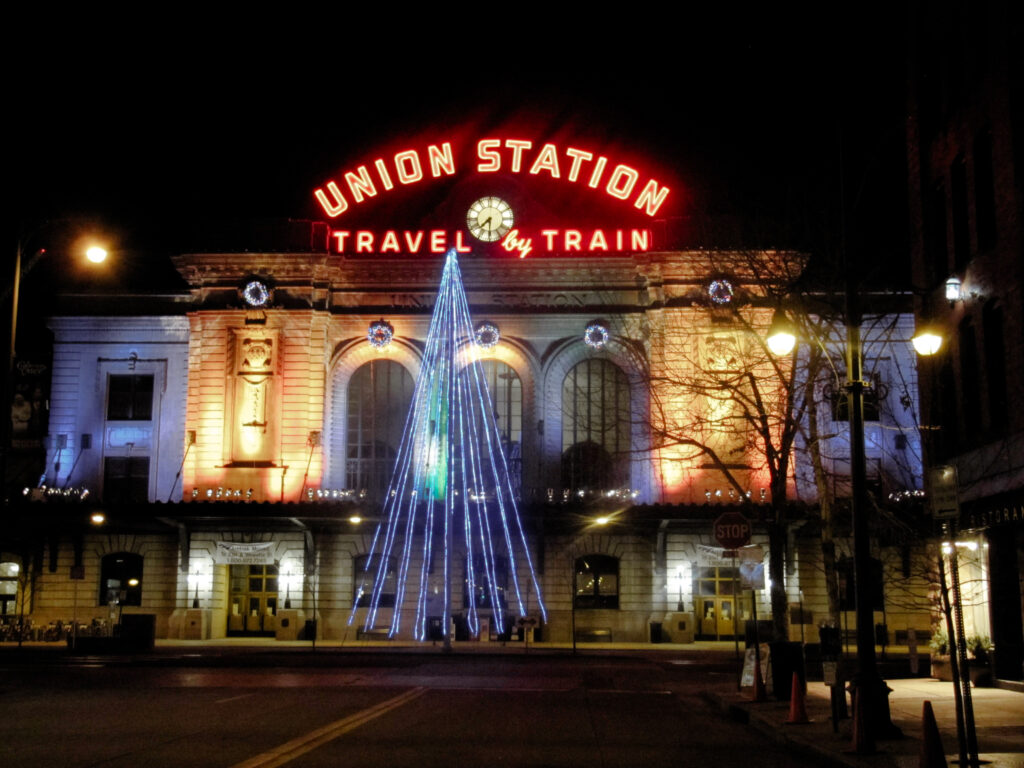

As Denverites give 2025 the bum’s rush, traditions abound in all shapes and sizes. Whether it’s finishing off Christmas tamales, making black-eyed peas for prosperity, or giving a midnight kiss and toasting at midnight, the celebratory nature of ushering in the new year is all superstition for a better year than the last.
Newspapers had their own traditions, such as reporting on the first baby born in the new year and accounting for the highs and lows of the previous year.
Here’s a snapshot of how Denver rang in the New Year in 1926, 1976 and 1924
1926
New Year’s Day in 1926 was vastly different for Denver celebrants since the city and state were in the middle of Prohibition.
The Rocky Mountain News reported that only 21 revelers were arrested, seven for intoxication, four for bootlegging, four for contributing to disorderly houses and vagrancy and five were held for investigation, one for intoxication and reckless driving.
Skating parties were all the rage 100 years ago to celebrate the new year. Huge bonfires on the lake banks of Berkeley, City Park and Washington Park lakes were crowded all day. On New Year’s Day, the Grand View Improvement Association held a skating carnival at Rocky Mountain Lake.
Some traditions remain the same, as many people in the Denver area deserted the city and welcomed the New Year by heading west to ski, snowshoe, and toboggan at parties in the mountains.
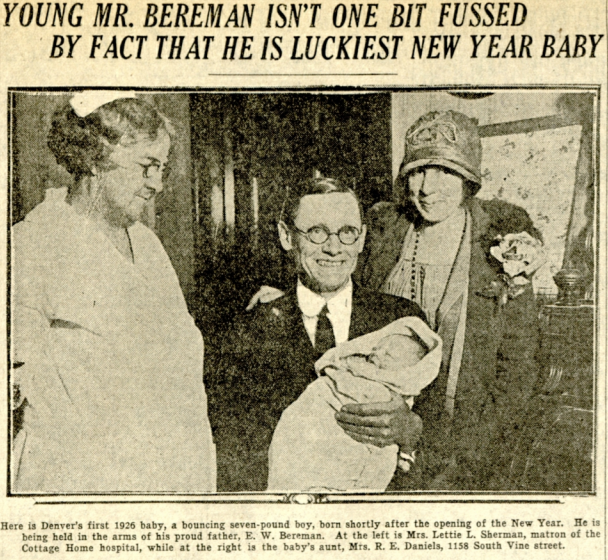
1926 also welcomed the New Year baby, a 7-pound newborn boy. His father, E.W. Bereman, held the child in the Jan. 2, 1926, edition of the Rocky Mountain News.
Sadly, the new year also brought the first death of 1926 with the passing of Mrs. Sarah Smith, 35, of 2031 California Street, who was taken to Denver General Hospital, where she died from epilepsy.
Doctors were kept busy at Denver General with treating ailments like a frozen foot, a teenager suffering a cut on his hand after falling while skiing at Washington Park, and a fractured rib from a car accident.
Denver Firemen were kept busy with calls like rescuing a toy balloon that flew away from the 7-year-old son who lived at 2826 Welton St. The toy balloon flew to the top of the two-story house. Three fire trucks arrived on the scene and left without rescuing the balloon.
Nationally, the Tournament of Roses parade in Pasadena, California, was marred when a temporary stand collapsed, injuring 250 people, with three confirmed deaths at the time of reporting. Caroline Sherman, 35 of Long Beach, Calif, died from shock of witnessing the accident. She wasn’t in the grandstand and died from a cerebral hemorrhage; two other women who were in the grandstand killed from fractured skulls.
1976
Fifty years later, Denver ushered in 1976 with one of the season’s biggest winter storms, bringing 8 to 12 inches of new snow.
While there were no major outages in town, the city estimated at least 200 car accidents from the slick conditions.
1976 was also the start of Colorado’s Centennial Year Celebration. Reportedly, the first baby born in Denver and Colorado was Joshua Nathan Mesch, who was born at 12:03 a.m. at Denver General Hospital.
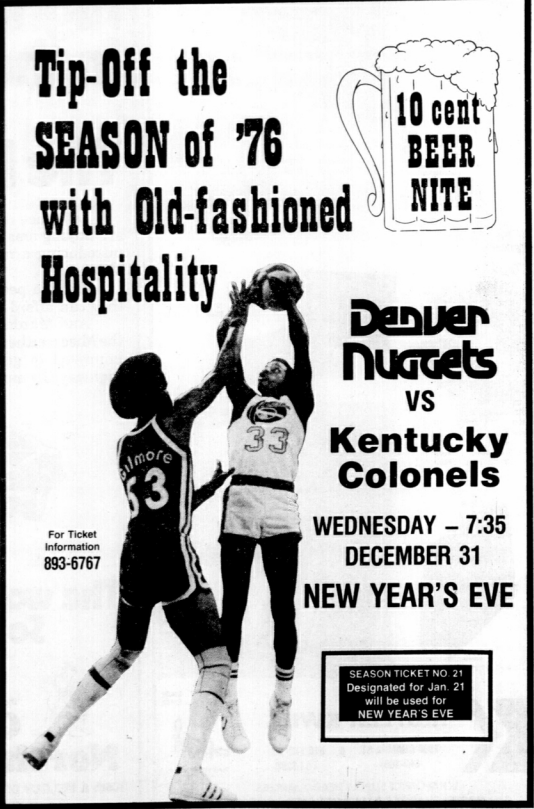
The fledgling ABA Denver Nuggets found a creative way to attract fans to their New Year’s Eve game at McNichols Arena.
The new professional sports league on the block promoted a unique way to attract New Year’s Eve partiers.
The fledgling American Basketball Association’s Denver Nuggets hosted a 10-cent beer night (roughly 57 cents in 2026) and prepared for a potentially popular event.
Promoters of the event didn’t expect a massive turnout given slick road conditions and other events competing with the Nuggets, but 11,555 fans made their way to McNichols.
It was reported that nearly 200 10-ounce cups of beer can be drawn from a single keg. The Nuggets had 400 kegs on hand, which would amount to 80,000 10-ounce beers. Without accounting for spillage, Nuggets fans consumed an average of 6.9 beers, drawing from 3.2 Miller, Coors, or Schlitz beers.
1924
On New Year’s Day 1924, the Rocky Mountain News readers woke up to two separate fires that killed two women and sent a half dozen to the hospital. The fatal fires were two of a dozen reported across the city in the past 24 hours.
The first fatal fire broke out shortly before 6 o’clock in an apartment house at 1305 Acoma. The second came an hour later in an apartment house at 2108 Tremont Place.
At the Tremont apartment, Beatrice Jones, 38, suffered mortal wounds when she leaped from a window onto an iron gate. She jumped from her second-story window to escape the flames. She was a teacher at Aaron Gove High School.

At the Tremont apartment, two other women, including Skinner Junior High School teacher Mary Olson, suffered severe injuries. Olson sustained severe burns and “probably fatal” injuries as she leaped from her window. Saleswoman Evelyn Laureman suffered injuries when she jumped from the Acoma Street porch.
Beatrice Duskey, 21, a telephone operator at the main exchange, suffered a fractured right leg, internal injuries and burns after leaping from a third-story window.
Beatrice’s roommate, Ula Kramer, 28, was trapped inside the apartment. Earl Duskey attempted to rescue his fiancée, but the fire cut him off from getting to his fiancée. He reached the roof and tried to hold on for his life, but fell and was impaled on the sharp pickets of an iron fence. Reporters noted that he fought for survival, but physicians at the county hospital gave him no chance to live.
Ula and Earl were engaged less than a year before the fire took their lives. Her parents moved from Cincinnati to Loveland. The News reported that the parents wanted them to stay overnight, concerned about the frigid temperatures.
Earl died a few days later from his wounds.
The fires claimed another life when Myrtle Wheelock, who fractured both of her legs and suffered severe injuries and burns, succumbed to her injuries a few days later, bringing the death count to four.