
One person’s vice is another’s opportunity. Decades before the Smaldones captured the headlines and attention of Denverites, a feud between two rival bootlegging organizations fought for control over Colorado’s thriving soda shop market.
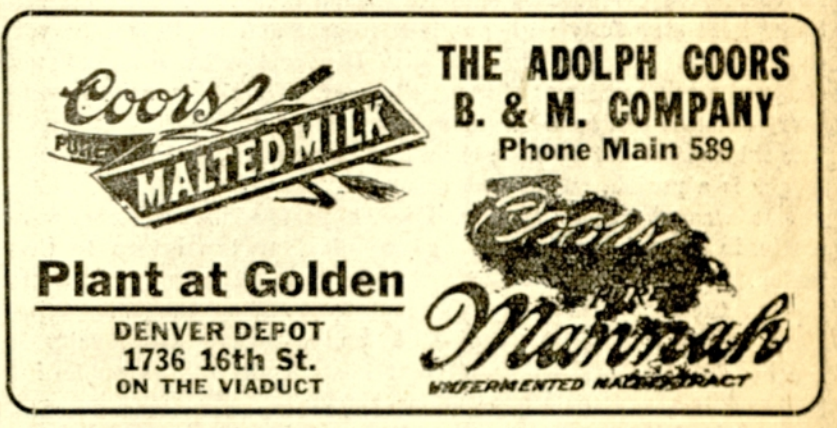
Such was the case during the Prohibition era, when Colorado and the rest of the United States spent more than a decade criminalizing alcohol consumption. Colorado had a head start by passing Prohibition laws in 1916, converting bars and pubs into soda shops across the state, including in Denver. Breweries like Coors turned to malted milk and porcelain manufacturing to survive the rough times, while others closed up shop, unable to adapt.
And while the temperance movement outlawed alcohol, it became a chance for others to become wealthy who had nothing to lose to quench the thirst of those looking for an alcoholic beverage. There were plenty who wanted a piece of the action with homemade stills and supplying bathtub gin or moonshine, but the real piece of the action came from running alcohol from Canada or Mexico.
The Italian mafia, or “black hand” as the press labeled them, ran bootlegging operations through Colorado. Denver had its own organized crime family in the Northside, but the power ran through Pueblo, Colorado. Then, a single moment in 1922 sparked a war of vengeance between two rival factions.
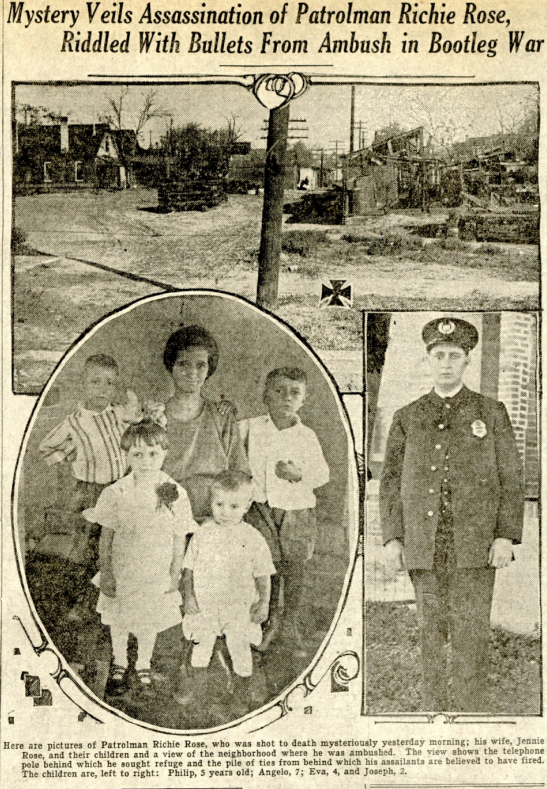
On October 31, 1922, a 30-year-old Denver rookie patrolman, Richie Rose, left his house to continue his rounds in North Denver. He stopped by his home on 37th and Kalamath to check in on his pregnant wife and children, as he usually did. The Italian community settled around Northwest Denver and bootlegging was big business. Soda fountain shops were covers for speakeasies and it wasn’t uncommon to read about bootlegging raids daily.
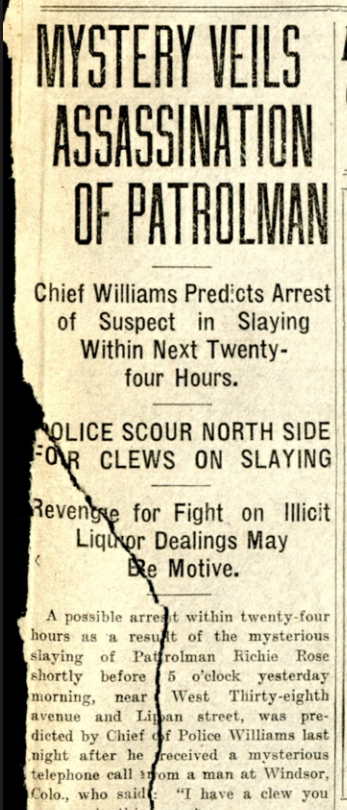
According to reports from the Rocky Mountain News, the Denver police enlisted a few Italians on the force, but Richie Rose joined in 1921. He was considered a clean cop who did not take bribes from those running alcohol throughout North Denver.
At around 5 a.m., Rose was at a call box near 38th and Lipan checking in with headquarters, but three unidentified men were lurking in a car nearby, ready to spring a trap on the officer.
As he was contacting police headquarters at a call box, three men sprang out of a car and started shooting at the police officer.
The Rocky Mountain News wrote:
“There are two piles of railroad ties near the spot where Rose fell. Assailants may have squatted behind them. Holes in the riddled telephone pole at the base of which the patrolman was found indicate, as do bullet marks in the wall of a terrace at 3811 Lipan street, that the assassins fired from all angles after surrounding their victim.”
Rose crawled behind the telephone pole for protection as he tried to call for help, but it did little good.
Supposedly, one of the assailants stood over him and pumped bullets into him. The coroner later reported that 21 bullets entered Rose’s body.
The Rocky also reported that his wife ran to her husband, while his brother Jim F Rose ran out as well after hearing the gunshots.
“‘They shot me — three men in a car. I don’t know who it was,’ gasped the dying patrolman as his brother reached him.”
His brother ran to a nearby soft drink place at 3759 Lipan and asked the owner to help carry him there. They phoned the police, and Officer Rose was taken to Denver General Hospital and died at around 6:15 a.m., unable to provide more information on what happened.
The police reported that the unidentified shooters used at least three guns: a double-barreled shotgun, a .32 Colt, and a .32 automatic of unknown make.
Search for a Suspect
The police rounded up suspects all around the Northside and theories abounded on why Officer Rose was ambushed. Some felt that Rose gained a reputation within the community as an enemy of the neighborhood bootleggers. Rose participated in many raids and arrested bootleggers and moonshiners in North Denver, which wouldn’t make him popular with some in the community. The Chief of Police was confident that they would find the killers.
Sicilians were targeted in the investigation, including Joe Calabrese, who lived at 3414 Nvajao, and was detained for a threat he made on Rose.
“You’d better call Richie off,” Calabrese is said to have warned Jim Rose a few days before the shooting. “If he doesn’t lay off, something is going to happen to him.”
Calabrese initially denied making the remarks but admitted them after questioning. He also stated that he can offer an alibi that he was out of the city when Rose was ambushed.
The Denver Police also asked for assistance from his brother-in-law, Jim Urso, a steelworker from Pueblo who was in town at the time. Urso was reported to have laughed at the request and told the police that if he found out anything, he would handle his own affairs and that the police would hear about it afterward.
Unusual Funeral
Richie Rose’s funeral was held on a rainy November day, which included over 200 uniformed police officers and hundreds of other family and friends, and also six unexpected funeral crashers wearing the white robes of the Ku Klux Klan. The leader of the group placed a floral white cross with a red base at the head of Rose’s grave.
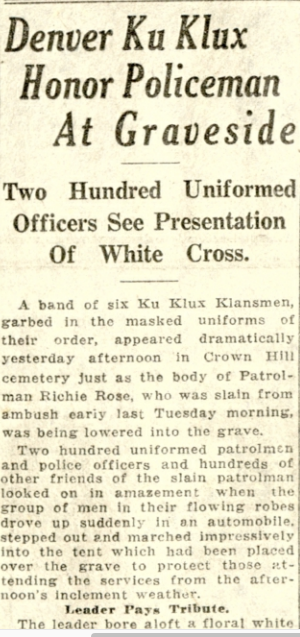
“Patrolman Rose was not a member of our order,” he said, “but it is our custom to show our appreciation of valiant service in the line of duty by these rites on such occasions. Patrolman Rose died valiantly while fulfilling the oath of his office as an officer of the law. That is why we are here today.”
Cold Leads
The Denver Police continued to bring in persons of interest in the Rose case, but there was insufficient evidence to tie any suspect to the shooting. Jennie Rose gave birth to a daughter on April 11, 1923, who was receiving a $ 60-a-month pension.
The trail for the killer was cold, but the police investigated the sudden death of one of Rose’s friends in May 1923 after his friend Mike Bruno died suddenly. The 32-year-old Bruno was the proprietor of a soft drink bar on 19th and Welton.
He checked into a hotel at 18th and Lawrence and was assisted by a hotel employee into a room. The hotel employee called the cops, who found him dead in the hotel room. Initially, the police thought he may have been poisoned, but a few days later, a Denver coroner said that Bruno died from an enlarged thymus gland in his neck.
Even though leads were running cold in Denver for the murder of Richie Rose, the battle between bootleggers was heating up in southern Colorado and victims included familiar names to the Rose family.
Reasons for the Shooting
For nearly a decade, the Rocky Mountain News postulated that the officer’s killing was tied to the blackhand aka, aka the mafia. The Carlino gang was the organization dominating Pueblo’s bootlegging scene; they had stills all over southern Colorado to supply liquor to Colorado towns, but a neighboring ranch run by the Danna family had its sights on controlling the lucrative liquor business.
In a short amount of time, neighbors turned into bitter rivals and first blood was drawn when two killings that were not included, but predated Patrolman Rose’s death, were those of Pellegrino Scaglia, aka Frank Viola, and 7-year-old Frank Cardino, who were killed on May 6, 1922. The two were shot to death by shotgun blasts while riding in a horse-drawn wagon by assailants in a car.
According to Sam Carlino, who wrote “Colorado’s Carlino Brothers: A Bootlegging Empire, Scaglia was the head of the mafia in Pueblo and his killing set off the feud between the Danna and Carlino gang vying for control of Colorado’s bootlegging operations.
Following Rose’s death, four associates of the Carlino gang were killed, including John Mulay Sr. (Feb. 27, 1923), Vincenzo Urso (June 19, 1923), and Dominic Ingo and Carlongero “Charlie” Carlino (Sept. 10, 1923).
Urso was the brother-in-law of Rose, and when Denver Police rounded up suspects from Rose’s killing, the police detained Urso and pleaded with the brother-in-law to help. But he only responded with, “I find out, maybe, I tend to ‘em. You find out after that, maybe — that’s all.”
The death of the Carlino’s youngest brother was a blow; they enacted their vendetta on the Danna family with a string of 10 deaths over 6 years, including all of the Danna brothers, John, Pete, and Tony. The recorded killings ended with the murder of Sam Danna on May 6, 1930.
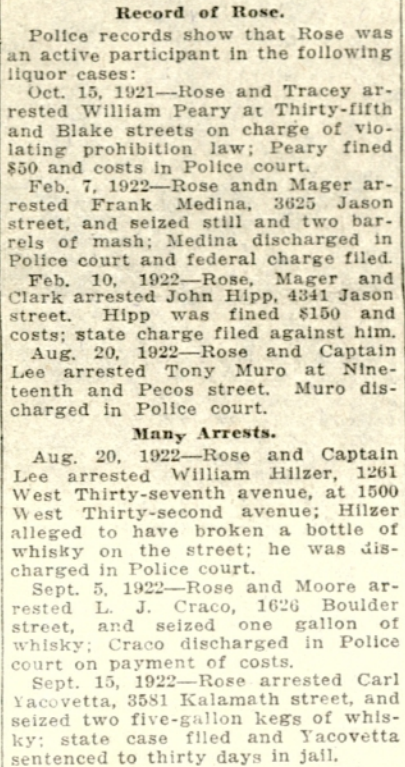
One other strong suspect in Officer Rose’s death can be found in an article detailing the various arrests he assisted with during his short time as a police officer. The Rocky Mountain News noted the cases he was involved with busing next-door neighbors and shutting down soda fountain shops-turned speakeasies.
On August 20, 1922, Rose charged Tony Muro with violating the prohibition law and a few days later, the Manager of Safety revoked his soft drink license. His soft drink shop was on 2520 19th St, near 19th and Platte.
Speculation aside, the truth behind what happened to Richie Rose and the people behind it continues to be a 103+ year mystery.