

Generations of Northsiders grew up with the story of Spider-Man, a supernatural creature that was said to lurk in the attic crawl space. Every slight bump was thought to be Spider-Man crawling around and staring at you from the air vents, checking to see if it was okay to be in your house.
But the origins of the real-life Spider-Man of Montcrieff Place are too sensational to be true.

Denver in 1941 was a different city from the bustling one of today. The West Highland neighborhood felt more like a close-knit town than a trendy area. On October 17, 1941, neighbors on Montcrieff Place grew concerned about the elderly Phillip Peters, who had spent weeks at home alone after his wife was hospitalized to mend a broken hip.
Phillip and Helen Peters were a familiar and well-loved couple in the West Highlands. They were considered the adopted grandparents of the working-class neighborhood. So much so that Phillip regularly sat at a next-door neighbor’s dinner table while his wife was recovering from hip surgery.
Some grew nervous because they hadn’t heard from him all day. A few went to his house to check on him. Not a sound came out of the house. Eventually, they called the police, but before they arrived, a few brave souls managed to find a way into the house.
After opening the door, the small crowd crept in to see what was going on with Phillip.
A Ghastly Scene
As they made their way inside, they discovered the grisly scene played out in different rooms, starting in the kitchen, a blood trail showed the violent act set upon Phillip, bloody and battered in the first-floor bedroom.
The police quartered off the house and as the detectives investigated the scene the moments of madness told the tale of what happened. There were broken canes in the living room, and splatters of blood showed that Phillips was attacked in the kitchen with a stove shaker, bludgeoned mercilessly as Phillips staggered from the kitchen to the living room. He tried to fend off his attacker with canes, but the splintered remains proved they offered minimal defense.

The assailant continued to pummel the railroad accountant until he lay motionless in the bedroom.
From the outset, the police investigated Phillip’s death as a murder, but were puzzled over what happened. The clues in the kitchen pointed towards the attacker desperately washing the bloodied stove shaker with water to wash away their fingerprints.
The coroner reported that Phillip had at least 30 wounds on his head, two of which punctured his skull. There was no evidence that burglars had ransacked the house or that any valuables had been stolen. And aside from the gruesome scene, it remained undisturbed and as quiet as a tomb.
A Haunted House
Weeks after the crime, the story took a supernatural turn. Peters’ widow, Helen, continued to live in the house for a while. She was not home the night of the gruesome murder; Helen was in the hospital recuperating from surgery. In rapid succession, two housekeepers quit their jobs and fled in horror after encountering a shadowy figure lurking in the house.

Helen was alone in the house, mending her hip and telling others she had described a supernatural presence wandering around. She moved some 240 miles away to Grand Junction to live with her son. The house remained empty for months and, thus, gained a haunted reputation. Neighbors would call the police to report “ghost lights’ coming from the abandoned home.
Every time the police searched the house, they found no evidence of an inhabitant.
They went as far as to conduct stakeouts across the street from the ghost house to find clues about the reported haunted house.
The Killer Revealed
But one night in late July 1942, the aroma of coffee from the house revealed the figure behind the ghost lights. Neighbors spotted a figure in the kitchen. They called the police, who returned to find that the stove in the kitchen was still hot and the air smelled of fresh coffee.
Denver police officers climbed the stairs to the second floor and discovered that the bedroom door of what was supposed to be a vacant house was locked from the inside. They managed to open the door and saw a foot disappearing through a trap door to the attic crawlspace.

The police opened the door to discover a gaunt figure hiding in the crawl space. There wasn’t a ghost haunting the house. The reason why the police couldn’t find evidence of a suspect fleeing the scene was that the killer never left.
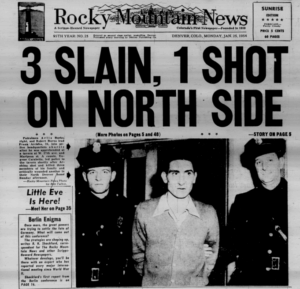
From the moment he was captured and escorted out of the Moncrieff house, the six-foot-tall, 93-pound man is known in Denver lore as the Spider-Man of Denver.
The ghost on West Moncrieff wasn’t a ghost at all. The specter was a flesh-and-blood man. He was nearly a shadow because of the way he hid out and lived in the attic crawl space for nine months.
The police and newspapers first knew him as Matthew Cornish, but after a few more interviews, they discovered his real name was Theodore E. Coneys. After several interviews with the suspect, the police started assembling the pieces.
Tragic Twist in Fate
Spider-Man’s sad tale began with his humble beginnings. During the interrogation, Coneys said that he grew up on a farm in Beloit, Wisconsin, but moved to Denver with his mother in 1907. His mother was a housekeeper at the Denver Democratic Club but passed away in 1911.
While in Denver, Coneys met his future victim at a mandolin society meeting hosted in Peters’ home on Moncrieff Place.
At some unspecified time, Coneys moved back east and worked as an ad salesman in Tonawanda, New York, but losing his job made him a vagabond, much like many during the Great Depression.

When he returned to Denver, he lived in flophouses on Larimer Street, but when he couldn’t afford those accommodations, he told the police that he had turned to Peters for help, who was in his early 70s. He said he was too embarrassed to ask his former associate for help, but instead found the infamous attic crawl space and became an unofficial roommate for five weeks before that fateful encounter.
During the five weeks Coneys was skulking out in the attic, Philip’s wife was in the hospital recuperating from a broken hip. While his wife was in the hospital, Peters had his nightly dinner at a neighbor’s house across the street.
The Spicer-Man’s Perspective
A Rocky Mountain News article described Coney: “Like a gaunt ghost, he stood numerous times beside the bed of his sleeping host during these nocturnal examinations of the house.”
Coneys would venture from their hiding place to steal food from the icebox.
But that October afternoon, the law of averages caught up with Coneys when Peters discovered his presence.

At one point during the struggle, Coneys reached for an old revolver that Peters used as a hammer and brought down the butt of it on his victim’s head. The rusty revolver broke into pieces, and that is when Coneys grabbed the stove shaker to finish off the 73-year-old Peters.
In a Denver Post story following Coney’s capture, the killer reenacted the scene for the police and demonstrated how he washed his bloody hands at the kitchen sink after the battle, rinsed off the shaker, and then slipped up the stairs to his attic, hiding place.
He hid in the tiny attic crawl space after the police discovered Peter’s body. He was in the house as the police collected evidence for the case and scoured the house to find clues leading to the phantom killer who they thought escaped the home on West Moncrieff Place.
Coneys was the ghostly figure that drove out two housekeepers and Helen Peters. After she moved to Grand Junction, the police turned off utilities and an empty fridge to determine if it was a ghost or a corporeal figure. These efforts didn’t deter Coneys from his nest. He scavenged for food in the basement, lived off strawberry preserves, and collected melted snow for drinking water. Coneys maintained his routine of scavenging and hiding in the crawlspace until that fateful summer day when he was arrested.
Spicer-Man’s Day in Court
Coney’s trial was held at the old West Side Court Building on Speer Boulevard and Colfax Avenue. He claimed self-defense for the attack on Peters, stating that he had been attacked because he had been caught raiding the icebox. To avoid the death penalty, Conley decided to take the stand.
Psychiatrist and observer to the trial, Dr. Leo Tepley, told a local reporter that the defendant was “a creature of complete frustration, crushed with the rejection by a society of the wares he had to offer.” He framed the story that Phillips’ attic became a haven for Coneys, giving him the long-sought seclusion from the society he hated for ignoring his considerable capabilities.

Under cross-examination, Coneys repeatedly denied that he intended to steal from his future victim. He had the opportunity following the murder, but Coneys said retreating to the attic was proof that theft wasn’t the reason behind what he did.
“I couldn’t have gone down. I was too numbed — yes, that’s it, numbed — physically and mentally. Good God! My only emotion was horror at what I’d done. I simply don’t have what it takes to be a killer.”
The plaintiff’s photographic evidence of the victim tore holes in Coney’s assurance that he wasn’t a killer. The visual proof evoked fear and apprehension from the defendant as the prosecutor instructed him to point out details of the death room. Lastly, the prosecution brought Phil K. Peters of Grand Junction, the son of the slain man, concerning the two pistols Coneys admitted using as a bludgeoning weapon. One was rusted and disintegrated on impact, while the other appeared from Peters’ drawer.
The younger Peters testified that he had examined the drawer the day before while searching for a tie for his father, but he testified that he hadn’t seen any gun. Nor did he notice the old, rusty gun about the house during his visits to his parents’ home. On October 31, 1942, the jury found Theodore Coneys guilty of first-degree murder and fixed the penalty to life imprisonment. The jury only took 95 minutes to find the Spider-Man killer responsible for Phillip’s death.
Coneys arrived at Canon City prison less than 3 weeks later to serve out his life sentence. He worked as a clerk in the prison electrical shop until April 1963, when old age forced his retirement to the prison hospital. He died on May 17, 1967. He was buried in Mountain Vale Cemetery instead of the prison graveyard in Canon City. He spent nearly 27 years being known as prison No. 22813 in the Colorado Corrections system, but Northwest Denver residents will forever know him as Denver’s Spider-Man.
*All images are from the Colorado Historic Newspapers Collection