

Cliches and inner circles are nothing new and in the burgeoning Queen City of the Plains, two women with vastly different origin stories helped put Denver on the map as a destination city for the wealthy and elite.
At one end of the Denver social spectrum was Louise Sneed Hill, a Southern belle who married Crawford Hill in 1895.
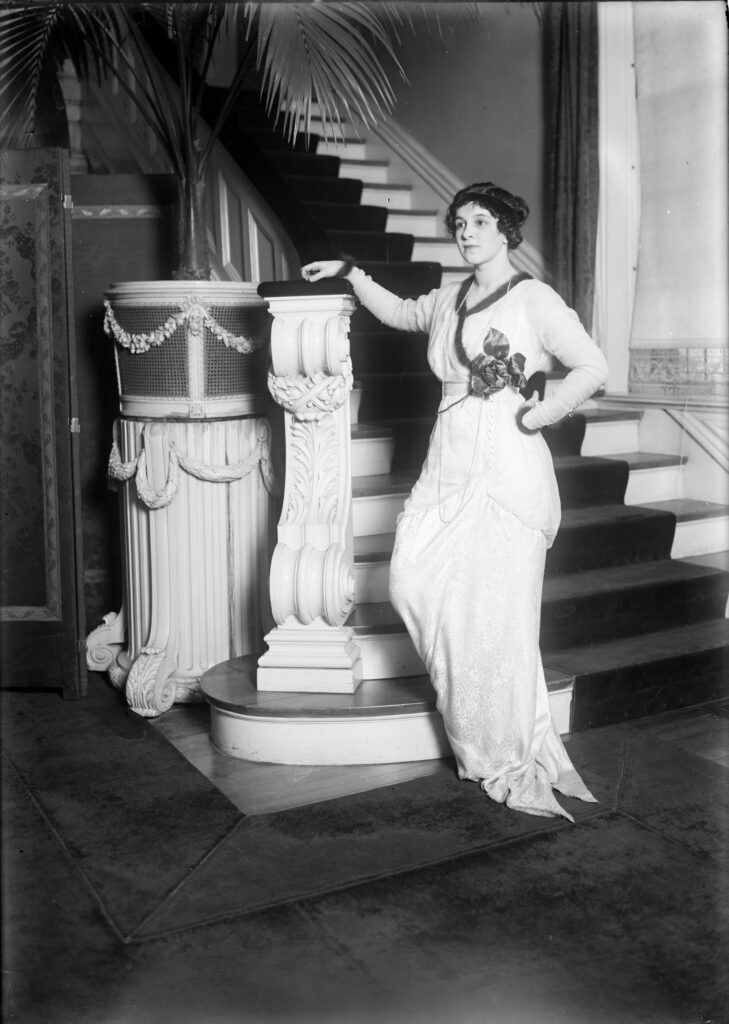
She met Hil, the son of Senator Nathaniel P. Hill, during a trip to Denver. The courtship between the two was short, and they were married in Memphis. “The bride wore an elegant white satin gown, and on her bosom sparkled the diamond, which was a gift from the bridegroom.”
For more than three decades, Mrs. Hill was the gatekeeper of Denver high society. She made powerful friends and charmed her way to being a 20th-century influencer on what was trending in and around the Mile High City. She also had a regular spot in the Denver Republican newspaper, detailing what’s hot and what’s not, and promoted or ignored Denverites.
Louise and Crawford set their sights on building a mansion that matched the unofficial power base of Denver society.
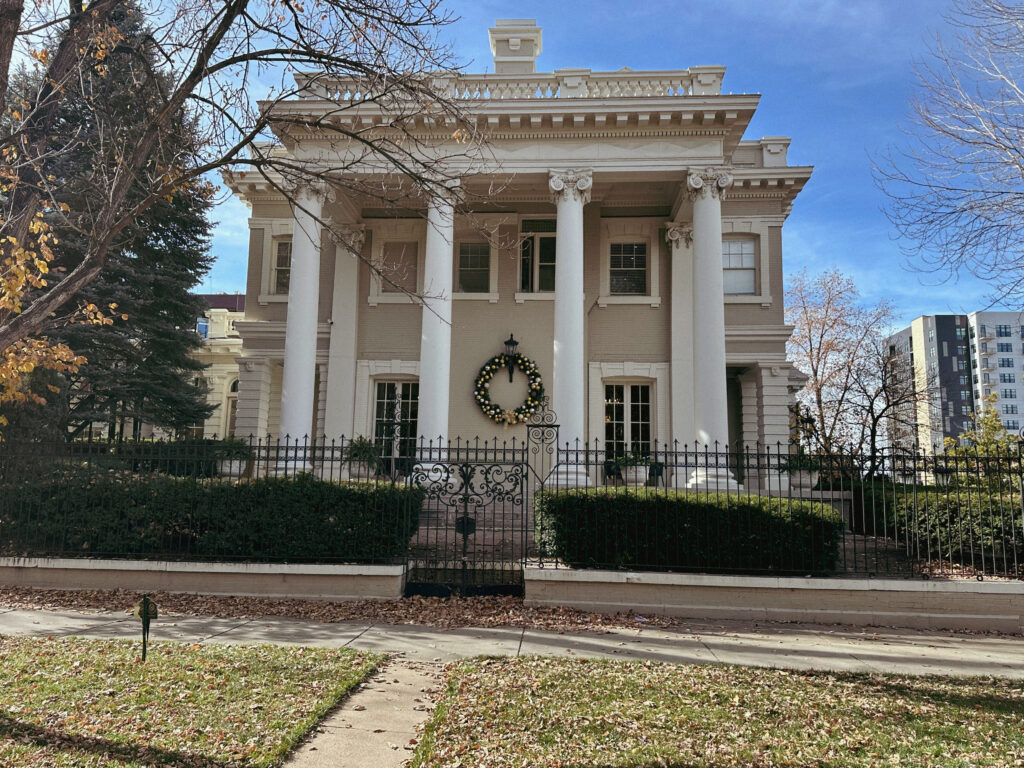
The Crawfords built their home in 1904 on the corner of 10th and Sherman, a gray brick French Colonial residence.
From her Capitol Hill home, she ruled over the “Sacred 36,” a group of Denverites who had the social influence to mingle with East Coast elites.
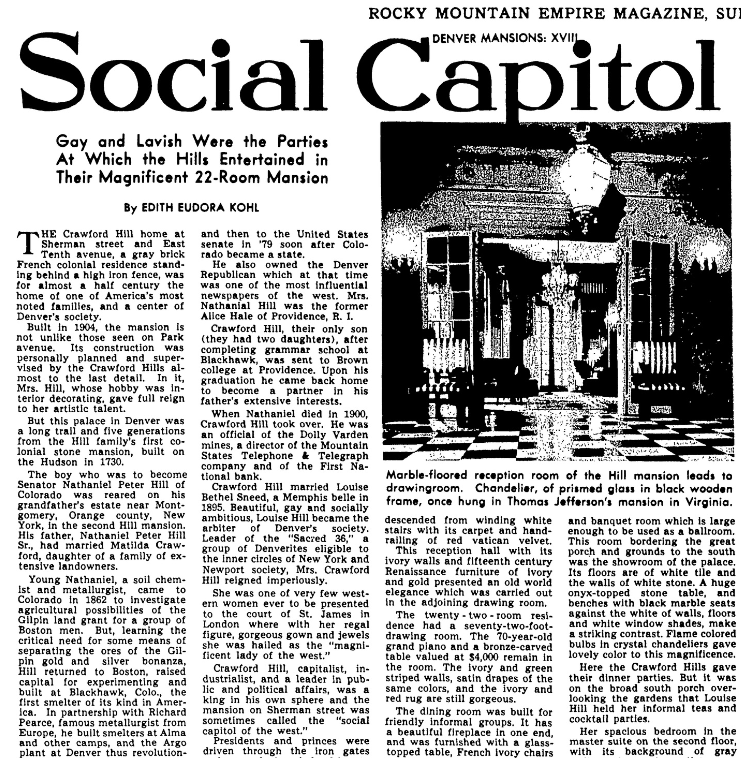
In Edith Eudora Kohl’s series on Denver mansions, she mentions that Mrs. Hill was one of the very few “western women to be presented to the court of St. James in London, where, with her regal figure, gorgeous gown, and jewels, she was hailed as the magnificent lady of the west.”
Presidents and princes were driven through the iron gates and around the circular drive to the stately entrance.
The 22-room mansion had a 720-square-foot drawing room. The reception hall was built with ivory walls and featured 15th-century Renaissance furniture crafted from ivory and gold.
“The room bordering the great porch and grounds to the south was the showroom of the palace. Its floors are made of white tile, and the walls are made of white stone. A huge onyx-topped stone table and benches with black marble seats, set against the white of the walls, floors, and white window shades, make a striking contrast. Flame colored bulbs in crystal chandeliers gave lovely color to this magnificence,” Kohl wrote.
But the queen of Denver society held court over her realm on the south porch overlooking the gardens, where she held informal cocktail parties.
Crawford Hill passed away in 1922, but Louise continued to live in the home. His two sons, Crawford Jr. and Nathaniel Peter IV to carry on the family. Both ended up with families back east, with Nathaniel marrying Elinor Dorrance, the heiress to the Campbell Soup empire, while Crawford Jr. married Ann Kaufman in 1923 and Evelyn B. Lowe in 1923 after divorcing Kaufman.
Louise carried on until 1944, when she moved into one of the Brown Palace apartments on the 9th floor.
The difficulty in maintaining the old gray mansion became apparent after it was sold and the furnishings were auctioned off at an estate sale.
Mrs. Hill continued to live at the Brown until she passed away at the age of 94 in 1955. She is interred at Fairmount Cemetery
There are rumors of ghost stories associated with Mrs. Hill and her former home. Some reported that random phone calls would go between Mrs. Hill’s former Brown Palace apartment and the Crawford Hill mansion, even when phone lines were not active inside the hotel room.
The Unsinkable Margaret Brown
While Louise Sneed Hill was the gatekeeper of Denver’s high society, Margaret Brown made her own way in high society, both in and out of Denver. Better known as the Unsinkable Molly Brown. There are a few who are unaware of Margaret Brown’s fame and reputation, as well as her role in Colorado history.
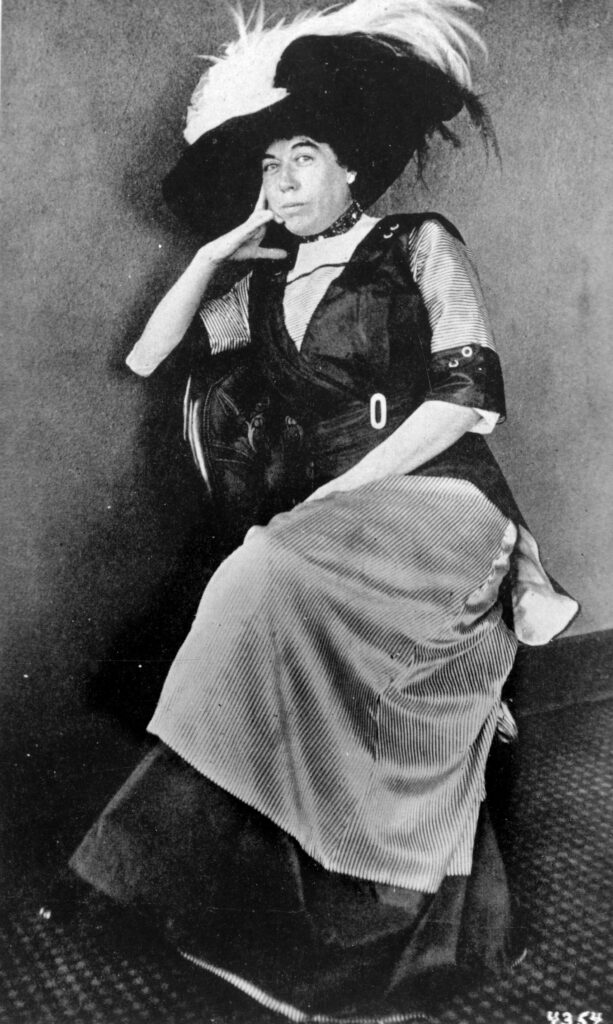
Plays and movies have been written about her legendary life, and her character played a significant role in James Cameron’s blockbuster film, Titanic. However, she started her life in a quiet corner near Hannibal, Missouri.
The 15-year-old Margaret Tuobin rode into Leadville, Colorado, in 1886 with her brothers and soon met her future husband, James Joseph. Brown, who was quickly becoming a skilled judge of claims and worked with prominent Coloradans, including David Moffat.
One of many legendary stories about the Browns was when JJ sold a claim for $300,000, took home the bounty in $1,000 bills to give to Margaret to stow away. She hid the money in the kitchen stove. But one night, JJ Brown came home and was chilly, so he decided to light a fire in the furnace, which led to his profits going up in smoke.
But a potential financial tragedy turned into a windfall when Brown struck the motherlode (or Little Johnny’s lode) with one of the largest gold mines in history.
The Browns relocated to Denver and purchased a Queen Anne-style house at 1340 Pennsylvania, designed by William Lang, from a family that needed money after the 1893 silver crash.
They moved into their stately mansion in 1894, around the same time Louise Sneed Hill made her introductions to the city.
In the Rocky Mountain News obituary for Margaret Brown, it recounted an embarrassing moment where a Denver reporter, Polly Pry, asked her to write an article for a Denver society magazine. Margaret wrote the article, but it was printed without being edited and included typos and grammatical errors.
Whether or not this anecdote is true, Margaret traveled the world to study music, literature, and to learn five other languages.
She did not make the list for Mrs. Crawford’s Sacred 36; however, she was welcome in many other circles and was included alongside international royalty, such as the Duchess of Vendôme, the Comtesse de Noailles, and Prince Wilhelm of Sweden.
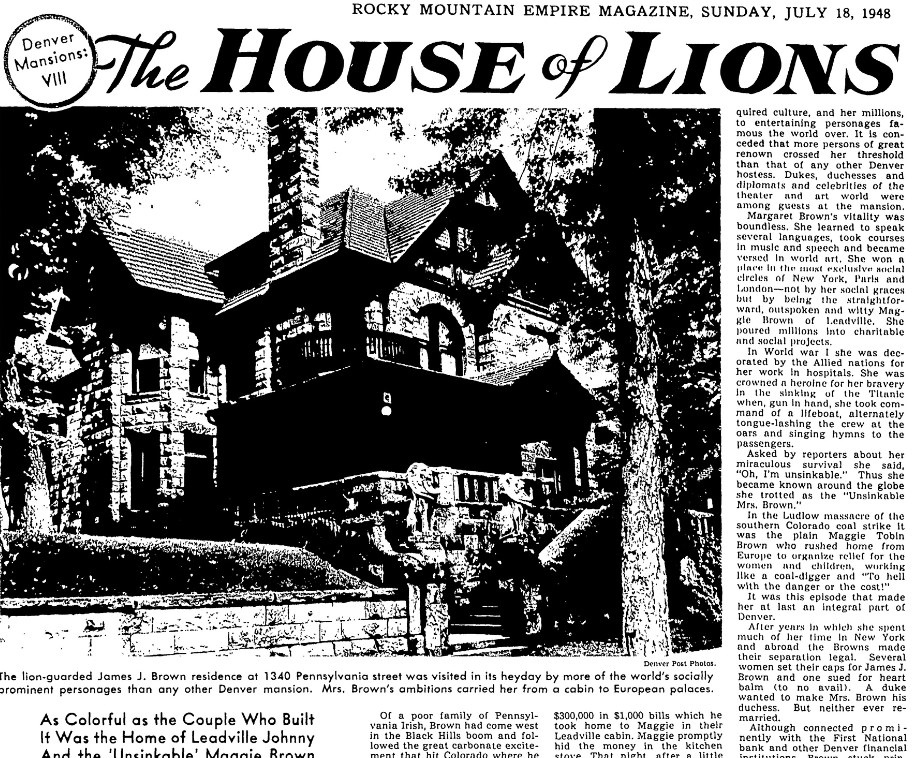
The House of Lions also made Kohl’s series of prominent Denver homes back in 1948. In the article, she described some of the unique features, including:
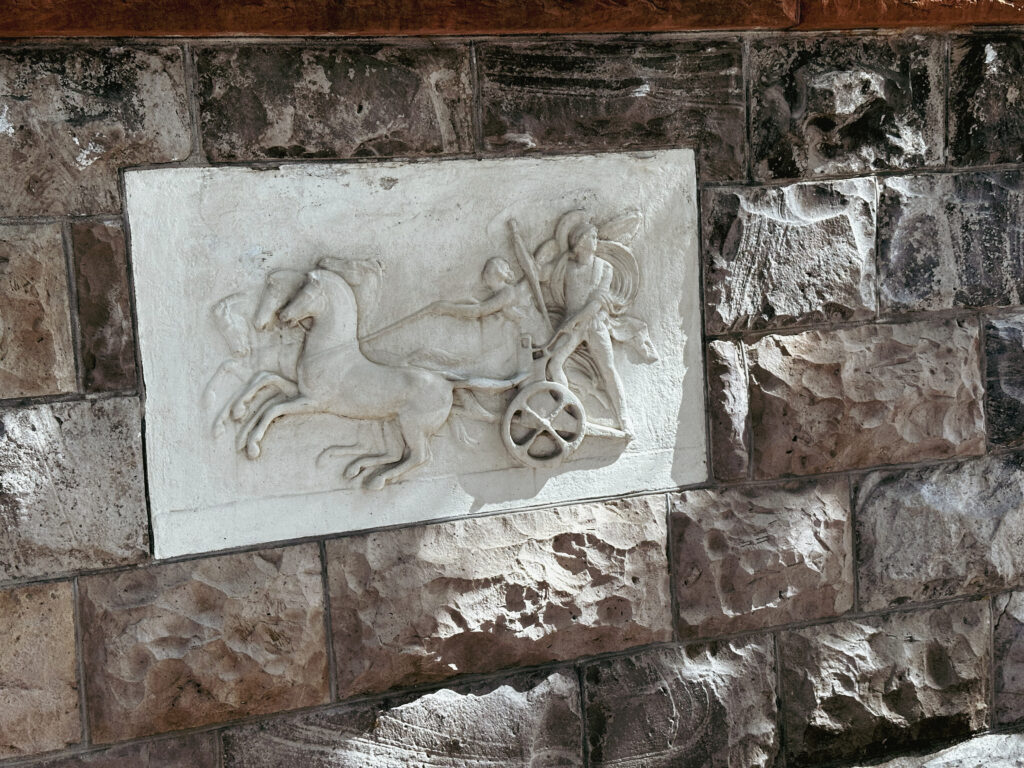
“But one of the most unusual features of the home remains intact in a granite inset of the old stone fence. All but hidden in the summer by the clinging vines is a bas-relief, reproducing in part a frieze by the famous Danish sculptor, Thorwaldsen, representing the triumphal entry of Alexander into Babylon. While he stands in the chariot, scepter in hand as an emblem of the imperial power, a woman representing Victory drives the horse. The original sculpture is in Copenhagen.”
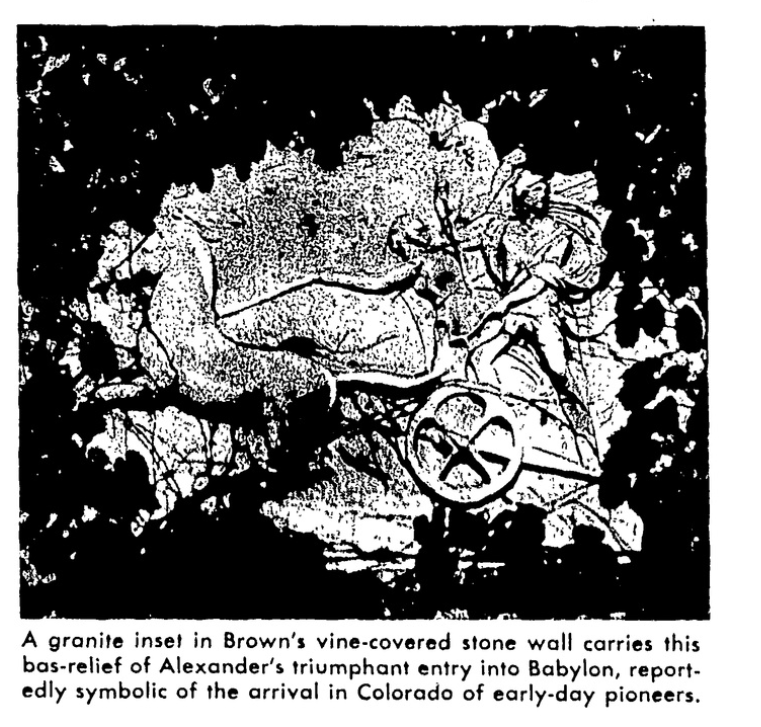
The inset still can be seen when you visit the house on 13th and Pennsylvania.
She entertained her friends with lavish parties that often served on golden plates.
Unfortunately, J.J. and Margaret separated, but she was a mainstay in Denver’s philanthropic work.
Her efforts in Denver included helping to raise funds for the Cathedral Basilica of the Immaculate Conception on Colfax and Logan, as well as contributing to the construction of a wing at St. Joseph Hospital.
She also helped to purchase and restore a house owned by poet Eugene Field.
“Before the gift was complete, she scrubbed floors, washed woodwork and polished windows in the house.” The house can now be found south of Exposition and South Franklin in Washington Park.
Also during World War I, she offered her services as an army nurse, but when that offer was rejected, she went back to Colorado to help organize relief for the wives and children of the Ludlow coal miners.
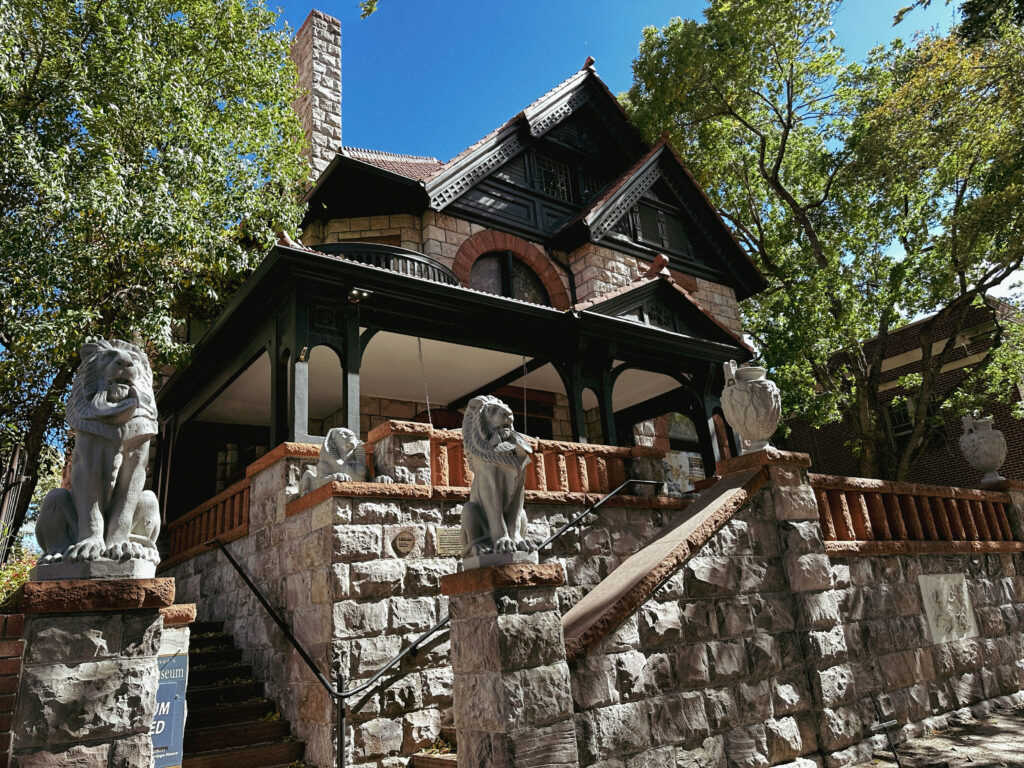
Margaret Brown passed away in 1932 in New York City at the Barbizon Hotel and was buried in the Cemetery of the Holy Rood in Westbury, New York.
The house was eventually sold after falling into disrepair, but it was later purchased by Historic Denver Inc. and restored to its early 20th-century luster. The house has been a museum since 1971 and is open to the public with guided tours, high tea, and special events.