

The journey to transform a prairie cemetery into a nationally-acclaimed botanic garden is as long and winding as the Oregon Trail.
There was no eternal rest for Denver’s first residents, as living Denverites near the new Cheesman Park still had thousands of quiet guests, whom they considered a health hazard.

It had been 16 years since the debacle that was the removal of bodies from Mount Prospect Cemetery to Riverside Cemetery, when the city decided to stop further internments at the Catholic Mount Calvary Cemetery and Jewish Sinai Cemetery. The city had plans to incorporate parts of these cemeteries into the Congress Park residential district.
While the ordinance passed in 1909 wasn’t entirely followed by some families, who wanted their loved ones buried at family plots.
E.P. McGovern made his way back into the news when the Colorado State Board of Health questioned him and two other undertakers to explain why they interned bodies in Mount Calvary Cemetery since the grounds were closed for new internments.
McGovern was the undertaker who was in charge of moving bodies from Mount Prospect to Riverside Cemetery in 1893, and he was told to quit the removal of bodies under duplicious circumstances.
Outlaw burial
In May 1911, McGovern was fired by a grieving family when he refused to inter the body of John B. Gargan. He prepared the body for his five brothers but told the family that he could not conduct a funeral in Mount Calvary.
The five brothers dismissed the undertaker and took control of the funeral. The Gargans had a family lot in the closed cemetery for 32 years and wanted to honor John’s request to be buried with their parents.
Following the burial, Frank E. Gargan, Thomas Shannon Sr., and Thomas Shannon Jr. were charged with burying a dead body without a permit.

The fine for burying a dead body without a license ranges from $25 to $100 (1911).
The charge was in a gray area since there was an effort to reopen the cemetery. The heated debate ended with the city maintaining a ban on reopening the site for burials.
In 1912, the Rocky Mountain News reported that unexplained monuments were being raised on empty lots in the cemetery.
The inscription detailed that the monument was for Sister Genevive and was a crude black cross and several granite blocks raised on the empty lot. There was also a white marble cross with a photograph of Sister Genevieve.
But as the years rolled by, the fight to bury family members waned. Eventually, Mount Calvary became a place with vandalism and pranks gone awry, including several people moving a headstone from the cemetery to the middle of the street. a Denver street.

The decline of Mount Calvary became apparent to many, including military personnel who were “shocked” by its conditions. One such letter to the Rocky was published in 1944.
“This morning, my girlfriend and I were walking through Cheesman Park, not a care in the world, when I noticed a cemetery in the distance, so we decided we would go see what a Colorado cemetery looked like. I wish I hadn’t because to tell you the truth, we were shocked beyond speech.
To start with, the headstones were knocked down and some of the graves were sunk in two or three feet. There were weeds all over the place, and rusty old tin cans thrown into some of the graves. Also, a lot of headstones had been used to break bottles. I’m not saying what kind because they were already broken.”
Expanding Denver’s Park System
Following World War II, Denver revisited the idea of incorporating Mount Calvary into the Denver Parks system, as discussions were underway with the city and the Catholic Church to acquire the land and relocate the 6,700 bodies to Mount Olivet Cemetery. Initially, the Rotary Club wanted to purchase the land for its international headquarters, but plans were abandoned. Mayor Quigg Newton sought to expand Denver’s park footprint by acquiring land to add to Cheesman.
In April 1950, Archbishop Urban J. Vehr offered to give the 19-acre tract of land to Denver for inclusion in the city’s park system.

In the letter Vehr wrote to Mayor Newton, he wrote, “I hereby offer to convey the land to Denver as soon as the remaining bodies are moved to Mount Olivet Cemetery.”
The archbishop assured that each body will be separately exhumed and re-interred with perpetual care at Mount Olivet.
As a part of the deal, the Denver City Council approved $80,000 to transfer 6,700 bodies from Mount Calvary to Mount Olivet.
Moving the dead was a meticulous process to confirm and respect the remains. Mt. Olivet Superintendent Elry F. Goebel was in charge of the operations and was tasked to oversee 12 workers who spent each day digging up the bodies, confirming the remains from the cemetery’s records and transferring the bodies to a new coffin.

The Rocky Mountain News chronicled the effort and the superintendent offered a few stories about the condition of the remains.
“We transferred the body of Mrs. Honra Gleason the other day,” he said. “I say body and that is what I mean. Her body was in perfect condition — there was no corruption at all. The flesh was smooth, pliable and soft. It contained the wrinkles you would expect in anyone of 78 years.
The body had been interned at Mt. Calvary for nearly 69 years when she died in Leadville on Sept. 13, 1881, and was buried a few days later.
Another story resurfacing to life included the tragedy of the Doyle family. In March 1884, an avalanche in Woodstock, Colorado, a town nine miles east of Pitkin, killed 13 people in the slide.
Marcella Doyle and her six children were caught in the avalanche. Mrs. Doyle was trapped for nearly 12 hours before being rescued, but her children were not that fortunate. The Doyle family members who lost their lives that day included Martin, 23, Andrew, 19, Katie, 18, Marielles, 14, Maggie, 12, and Christopher, 10. Before this tragedy, Mrs. Doyle had already lost her husband and two other children. Marcella passed away in 1906, joining her family at Mt. Calvary, along with two other Doyles who were buried and relocated together to Mount Olivet.

The exact amount of time it took to move the bodies is unknown. In November 1950, however, the city requested assistance in creating topsoil for the future park to supplement the grounds as they continued their on-site operations.
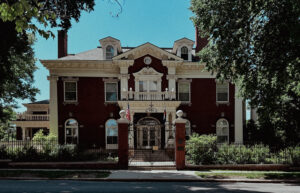
The site was vacant for nearly 8 years until it was announced that the 18-acre site would be the new site of Denver’s Botanic Gardens. The adjoining home on 909 York was purchased as part of the deal to be the headquarters for the Denver Botanic Gardens.
The groundbreaking ceremony took place on March 23, 1959, and at the time, it was considered the central botanical display between St. Louis and Los Angeles.
The first phase of the construction project was completed in September 1959, but projects like the Boetcher Memorial Tropical Conservatory did not go online until 1966.
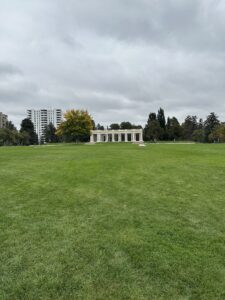
What was once a cemetery on the edge of the Rocky Mountains is now a popular site for Denverites and tourists. But echoes of Mount Calvary continue to be unearthed, as the Denver Post reported in 2008, a parking garage construction project on 10th and York unearthed remains left behind. All the discovered remains were moved to Mount Olivet to join the thousands of others to receive a proper burial.