



Amusement parks evoke a sense of nostalgia for countless Denverites across generations.
Children can mark rites of passage when they are tall enough to ride alone on the Wild Chipumunk or wooden behemoths like the Cyclone roller coaster at Lakeside.
But when you jump on Lakeside’s Cyclone roller coaster, always pay attention to the safety rules. Some are no-brainers, but remember that each rule makes its way on the poster for a reason.
For example, “Do Not Stand up when the roller coaster is in motion.” It seems like an easy one to remember, but there was a time when this was commonplace.
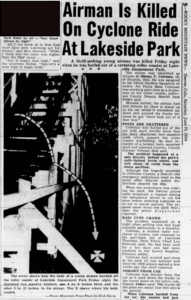
On June 18, 1954, a 19-year-old airman unbuckled his safety belt, stood up, and flew out of the Cyclone. The victim was Airman Third Class Danny C. Coleman, 19, from Houston. He was stationed at Lowry Air Force Base and worked part-time as a brakeman for the Cyclone.
Coleman was thrown out of the car and shattered two supporting posts for the roller coaster’s scaffolding. Jefferson County coroner said that Coleman died instantly and sustained a broken back, smashed skull, and internal injuries.
Park officials requested that the ambulance refrain from using its siren to avoid alarming other guests at Lakeside. Coleman was thrown from the car as it sped down to the lowest point of the ride, where the tracks were four feet from the ground.
Several of his friends had front-row seats in the horrific scene. Minutes before the accident, he told a friend that he liked to stand up in the roller coaster cars because he got “more kick out of it that way.”
Fire guts Lakeside Swimming Pool
In December 1973, parts of Lakeside became victims of a fire that nearly destroyed the amusement park.
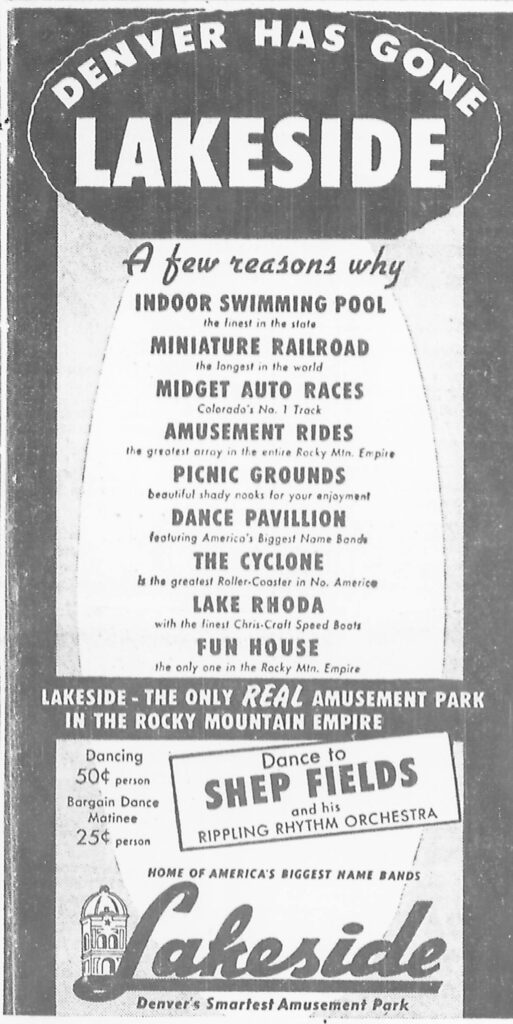
The Fire cut a trail through the old amusement park in the summer after a Jefferson County Grand Jury deemed it a public safety hazard.
Five fire departments worked to handle the blaze, which eventually destroyed the park’s old swimming pool and two maintenance shops along 46th and Sheridan. There were no injuries, but 100 firefighters halted the blaze and prevented the entire park from going up in smoke.
The safety concerns stemmed from a 12-month investigation that found all of Lakeside’s buildings to be potentially hazardous due to numerous electrical and fire code violations.
Despite the low water pressure and the initial chaos caused by the presence of multiple fire departments on the scene, the firefighters managed to keep the flames localized to the swimming pool and workshops.
Races at Lakeside Speedway screech to a halt
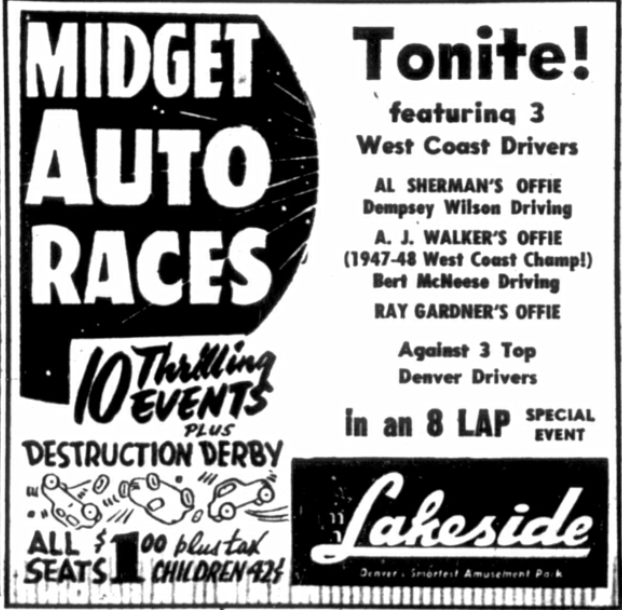
Adjacent to Lakeside Amusement Park is the long-abandoned Lakeside Motor Speedway, the home of midget race car racing, which started in 1938. The venue was on the verge of celebrating its 50th anniversary when calamity ensued.
On July 24th, Kristy Carlson died when another driver spun out of control and hit a guardrail at the speedway. The car careened several feet until it hit a traffic light. The impact spun the back end of the car into a chain link fence in front of spectators and shredded a wood fence.
Nearly 4,000 witnesses were on hand to see the accident, with a dozen spectators injured when the shattered board fragments went into the crowd.
Before the crash, drivers repeatedly requested track improvements, including the installation of a protective guardrail. Days after the accident, a flagman for Lakeside Speedway told a Rocky Mountain News reporter that it was only a matter of time before an accident of that sort would occur.
Lakeside announced it would prohibit racing three months later, ending a half-century tradition.
First reported death on Cyclone Coaster.
The Rocky Mountain News reported that on June 24, 1944, 20-year-old Bonnie Marie Hicks died almost instantly when she fell from her Cyclone roller coaster car as it swept out of control around the final curve approaching the loading platform, when another loaded vehicle was waiting to start the circuit.
Seven other passengers were injured when the two cars collided at the loading point. All of whom were passengers in the moving vehicle. Five were transported to St. Anthony’s Hospital with injuries ranging from a broken arm, various leg injuries, shock and bruises.
Park officials stated that the accident occurred due to a snapped coupling joint on the rod that loads the brake system, which slows the cars as they approach the platform, allowing the car to approach the stopping point at full speed.
Hicks’ body flew from the coaster car when it came around the bend leading to the platform. She struck a guardrail head first and fell into a flower bed before the tracks. The coroner reported that her death was almost instantaneous.
Bonnie moved to Denver from Greeley in 1942 and worked as a telegram sorter for Western Union Telegraph Co.
Bonnie’s death left an ominous tone over the rest of the summer season, but in less than a month, 1944 would lead to one of the deadliest fires at Denver’s first amusement park, more than a mile away from Lakeside.


