

The Rocky Mountain News was one of Colorado’s oldest newspapers, and for most of the 20th century, it had a problem it gladly welcomed: filling news holes on a daily basis. Newspapers once had armies of reporters canvassing their communities to tell the story of the times.
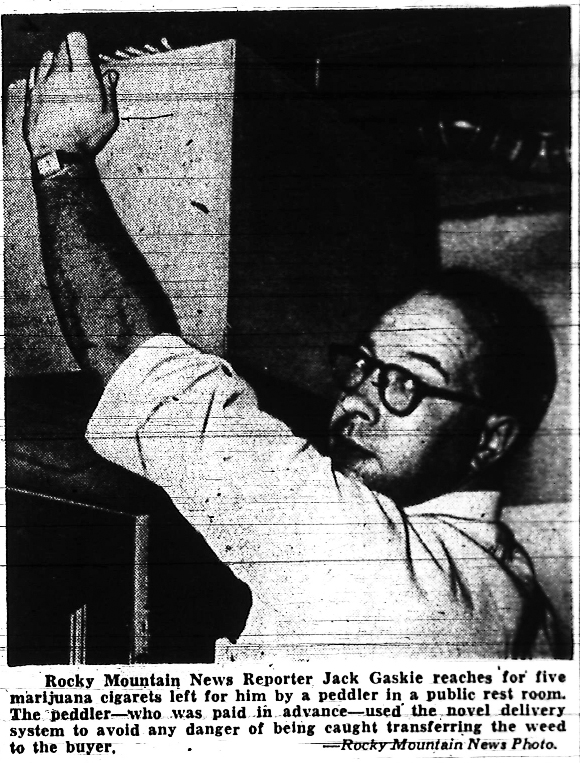
In the summer of 1951, Rocky Mountain News reporter Jack Gaskie went on a quest to see how difficult it would be for a regular Joe to buy marijuana in Denver. This was 15 years after the film “Reefer Madness” cemented the idea that marijuana was as dangerous as opium and heroin,
Gaskie’s journey confirmed that finding and buying illegal drugs, at that time, was framed as a dirty deed due to the product’s effects on the mind.
He pointed out that marijuana had a lot of different names: hay, tea, reefers, muggies, or mota. At first, he didn’t use these terms on his first attempt when he went to Five Points and asked a teenager who bolted after the question.
He thought that, at the very least, he would be sold Curtis Park grass, a trick played on novices in which they purchased grass clippings wrapped in cigarette paper.
Gaskie changed his strategy by venturing to an unnamed bar, having a few drinks, and, after a while, complaining about how Denver was a “dead, no good place where you couldn’t even line up for a ride when you were down.”
The bartender said he couldn’t help but give him the name of a bar on Larimer Street that might assist. He made his way there and picked a fight to grab attention. After this, the bartender motioned to a man named “Louie.”
Gaskie described Louie as a guy who wasn’t exactly the type that most Denverites would do business with, since he smelled like he hadn’t bathed for months.
Despite several attempts to win over Louie, Gaskie went home empty-handed the first night, but the following evening, Louie hesitantly sold him two joints of marijuana.
But he couldn’t take the joints back to the Rocky Mountain News newsroom and had to smoke them at the bar to prove that he wasn’t keeping them for evidence.
The next step involved Gaskie calling Louie until he answered the phone to buy more reefer, but it took another day of calling before he could set up another meeting.
Gaskie met him at the ballpark in City Park; when he saw Louie, he demanded five dollars. He told him where to go and find it, on top of a box in the men’s room. I went in and found a dirty old sheet of paper with five sticks of marijuana.
After further review, Gaskie reflected that buying marijuana wasn’t worth the effort in time and effect it had given.
“The marijuana itself was just about as dirty as Louie. It isn’t chopped very fine,” he wrote. “The growers and middlemen in the business aren’t very much concerned about competition, so no great effort to pamper their clients.”
The marijuana was just a dirty paper wrapped around chopped-up weed that burned acridly, pungently, and irritated the nose.
“It’s supposed to take you for a ride. I found it was, at best, a walk. It’s supposed to get you “high.” It didn’t get me any higher than a bottle of beer.”
Gaskie’s journey into the “underworld” of Denver reinforced the idea that marijuana was one of the many vices found in the hands of dealers and grifters, preying on excellent and naive citizens of the city. He noted that only the most addicted would go to the lengths he did to buy marijuana.
It’s doubtful anyone from that time would see that medical and recreational marijuana would fuel another boom 27 years later. The medicinal and recreational marijuana trade in Colorado is one of the strongest across the U.S.
Today, customers don’t need to hang out with a guy named Loui, but simply be over 21 years old and walk into a shop to purchase marijuana legally. The emphasis on quality control and customer service, which Gaskie complained about. One era’s vice is another era’s revenue generator.


