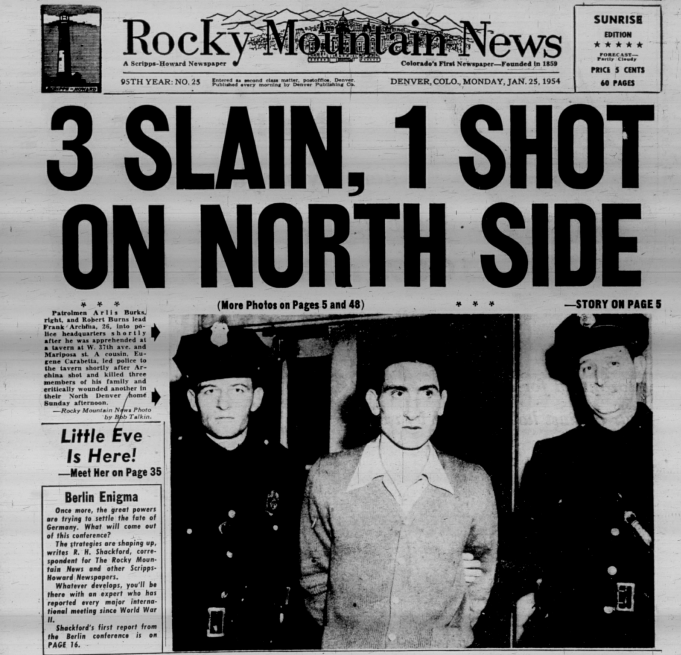

Family squabbles around the dinner table are nothing new. Still, on a sunny late January Sunday in 1954, a typical spat between a husband and father-in-law turned into tragedy in one house in Northwest Denver.
Family patriarch Frank Macri Sr. and Frank Archina were exchanging their usual verbal barbs when the altercation escalated into a matter of life and death.
The two men were arguing on the Macri front porch on 39th and Tejon when Archina kicked Macri Sr., stomped up the stairs to his carriage house and retrieved a shotgun from his bedroom.
Archina and his brother had married Macri’s two daughters, Rose and Mary, a year earlier, but hadn’t consecrated their vows formally in church or otherwise.
After the commotion on the porch, Frank Macri Sr. told his wife and daughters to hide in the bedroom as he grabbed his shotgun to face Archina.
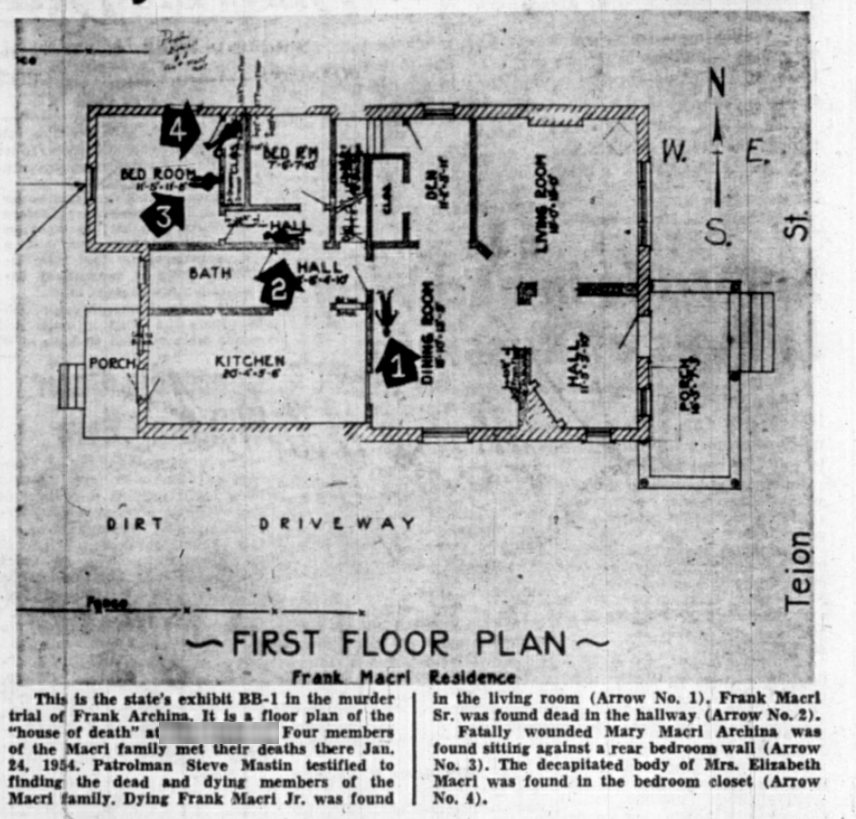
The two men again confronted each other in the living room. Nobody knows who fired first, but the elder Macri was on the floor from a shotgun blast to the chest. Archina proceeded to the kitchen and fired at Frank Macri Jr., mortally wounding him.
Two other family members, Steve Macri and Gene Archina, were outside when the melee started and heard shots coming from inside the house. Steve fled the house on 39th and Tejon to call the police while Gene fainted in the driveway.
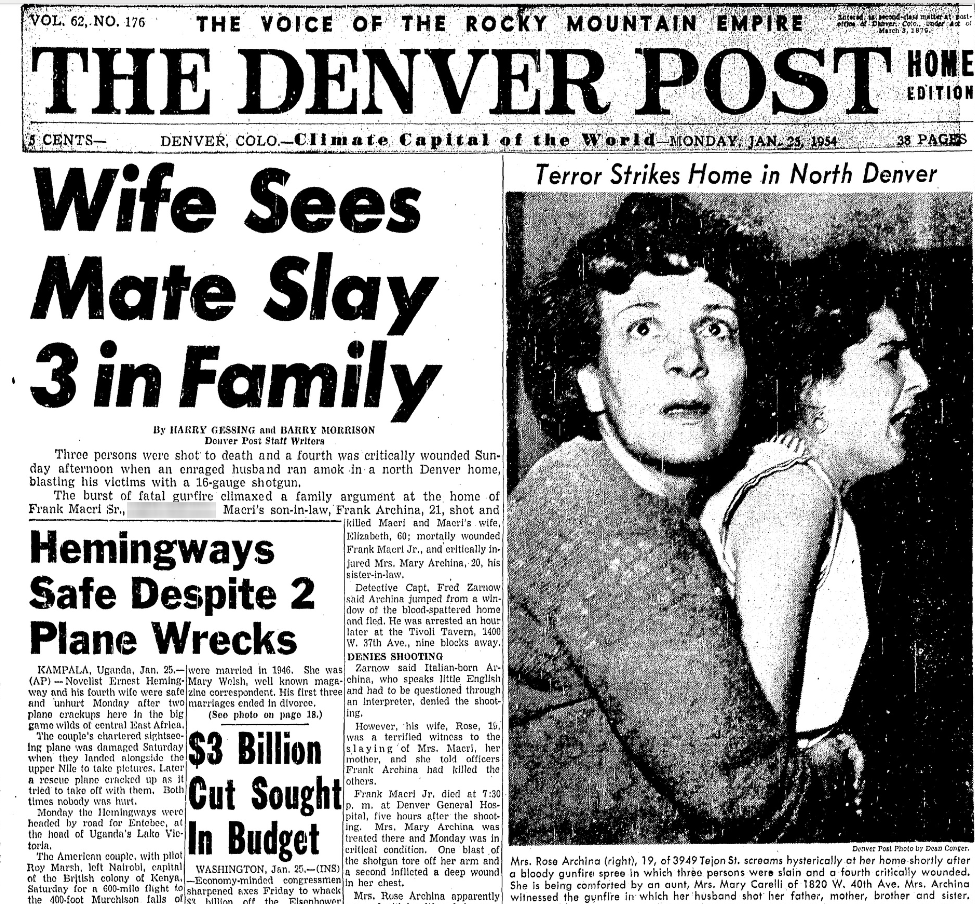
Frank Archina paused momentarily, reloaded his shotgun and proceeded to the bedroom where Elizabeth, Mary and Rose were hiding in a closet.
Archina threw open the door.
Elizabeth fell to her knees.
“Please don’t shoot! My God, please don’t shoot!” she pleaded in Italian.
Archina calmly leveled the gun and shot his mother-in-law in the head.
Archina turned his attention to his sister-in-law, Mary, aimed, fired and almost tore off one of her arms. Mary would succumb to her wounds a few weeks later, on February 10, 1954, making her another victim of this massacre.
After shooting Rose’s mother and sister, Frank turned the shotgun on his wife, aimed, and pulled the trigger, but nothing more than a click tore through the silence. Archina turned and ran to the nearest window to make his escape.
Rose followed suit and ran to the nearest neighbor. “Mother! My mother,” Rose screamed hysterically. “My husband did it! My husband did it!”
Within half an hour of the shootings, thousands flocked around the North Denver house.
The Hollywood image of sterile and well-groomed crime scenes didn’t exist. The police had to contend with a chaotic scene of family members and onlookers mingling around the Macri home.
Police combed the neighborhood around the Macri home for Archina. They jumped on a tip and found him at the Tivoli Tavern at 1400 W. 37th Ave.
As they walked into the bar, a police officer spotted Archina sitting alone in a booth. When he saw the officers, he rose to his feet, then raised his arms in a gesture of futility and gave himself up.
In Italian, he spoke to the arresting officer, “Are you going to kill me?”
“What do you think?’ One officer answered. “Don’t you know what you’ve done?”
Prelude to the Massacre
A decade and a half before this chapter unfolded, Frank Macri Sr. arranged marriages for his two daughters, Rose and Mary, to Italian nationals Frank and Gene Archina. In 1954, the entire family lived under one roof in a house on 39th and Tejon. It was a whole house with the elder Macri, the two married couples, Frank Macri’s wife, Elizabeth and older siblings, Steve and Frank Macri Jr.
Previously, Frank Macri had ties to the Carlino gang, who ran bootlegging operations in Southern Colorado. Their influence stretched northward to Denver, and Frank Macri, aka Frank Mina, was an associate tied to the group.
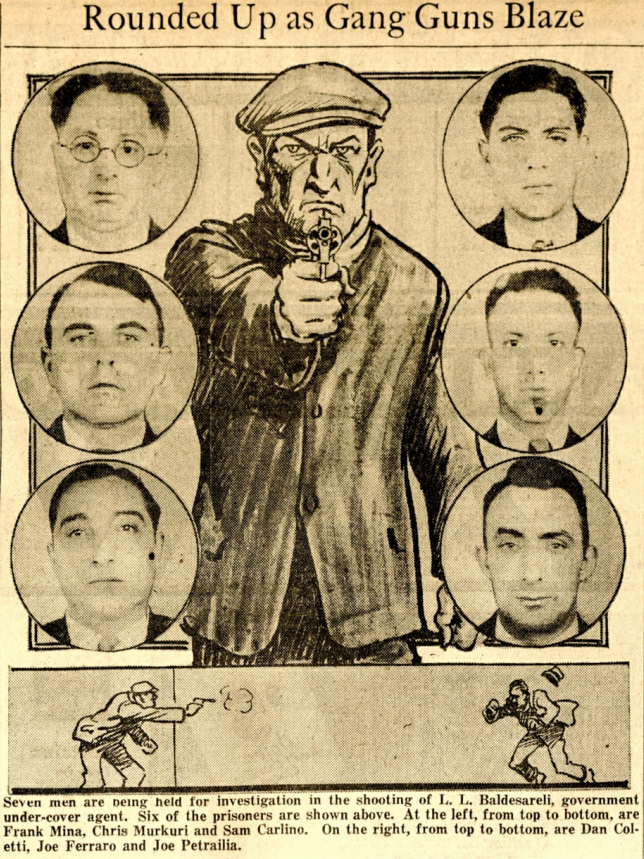
The Carlino organization was under scrutiny after an undercover officer, Lawrence Baldesarelli, was shot. Macri was arrested with others for questioning regarding the shooting. The case was eventually taken to trial, but in May 1931, federal Prohibition charges were dropped against the members of the Carlino gang.
Sometime in 1936, 18 years before the grisly scene took place, long before the Macri family even settled in Denver, they moved overseas to Italy.
The reasons behind the move are unknown, but at an unspecified time during their stay, Frank Macri Sr. arranged marriages for his daughters, Rose and Mary, to Gene and Frank, both of whom were extremely young.
By 1950, Frank Macri Sr. had returned to the U.S. with his two sons. Elizabeth, Mary, and Rose stayed behind until 1952, when civil marriage ceremonies were held to allow the Archina brothers to enter the United States.
And while Frank Macri was from Chicago, they chose to reside in Northwest Denver.
For Frank Archina, the honeymoon phase of his marriage never materialized, as the Macri patriarch prevented the couple from living together until a religious ceremony was held.
Frank Archina abruptly left the Macri household in New York City. His father-in-law spent some time convincing him to return home.
All the while, Frank Macri Sr discreetly explored the option of deporting Archina back to Italy.
Long Road to Justice
After he was arrested and taken to police headquarters, the one thing he complained about was that the handcuffs were too tight on him.
The Denver police had to use three officers as interpreters and all the while, Archina was pleading innocent, saying he didn’t shoot anyone.
Mary Archina spent weeks in the hospital fighting for her life, but she would eventually die from her wounds. She offered deathbed testimony confirming who the shooter was on that grisly January day.
District Attorney James Flanigan questioned her briefly after word of her condition deteriorated.
“Mary, can you tell me what happened at 3949 Tejon St on Jan. 24th? he asked.
“Frank shot my father, then my brother, me and lastly my mother,” she answered.
Two days after the brief conversation with the DA, Mary succumbed to her wounds and was buried alongside her family.
Frank Archina spent his time in jail pleading his innocence. Briefly, he staged a hunger strike. His defense team included a lawyer from New York City whom his family had hired, and also had psychiatrists testify that he was insane during the time and not competent to be put on trial.
The trial against Archina began in late August 1954 with jury selection. Still, it was halted on August 26th when Judge Edward C. Day declared a mistrial after a juror stated he was not physically or mentally well enough to handle the demands of the case. Judge Day set a new trial for Nov. 29th.
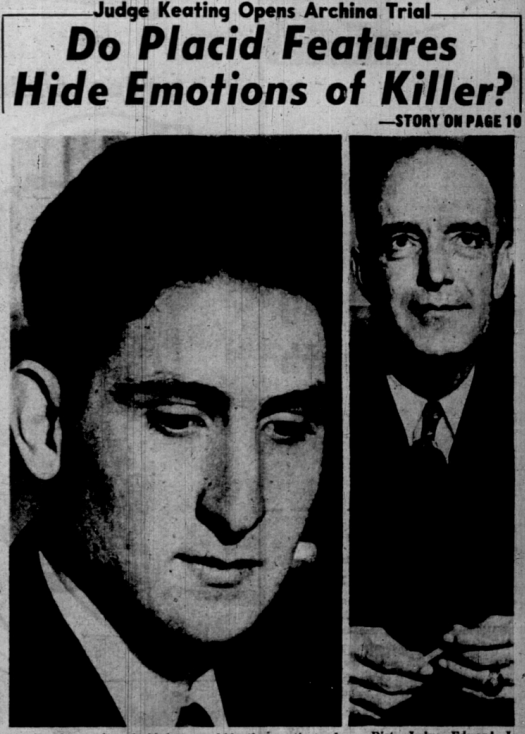
The trial was delayed again when a New York attorney defending Archina suddenly fell ill. The attorney, John F. X Sheridan, notified the judge of the illness. The judge was told that Sheridan had a sudden gall bladder attack and will be hospitalized for at least two weeks.
New year, more delays again when Judge Edward J. Keating, a newly elected judge, was assigned to oversee the case, due to the new judge’s trial schedule.
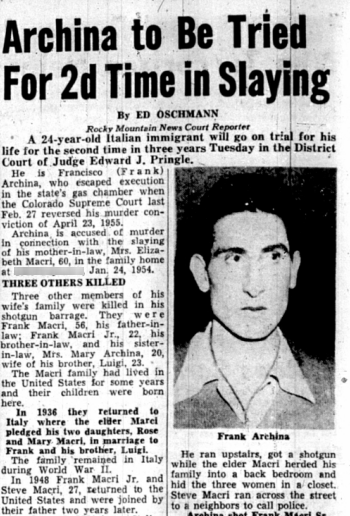
Finally, in March 1955, more than a year after the heinous crime, survivors Steve Macri and Rose Archina saw Frank Macri’s day in court.
When the trial began, Rose was the prosecution’s star witness, recounting the brutal details of the family. She had to testify that after Archina shot her father and brother, she heard him reload the shotgun before entering the bedroom.
She had to describe again how her mother pleaded for her life and that of her daughters.
She had to re-live on the stand at the moment of unlikely grace when Archina failed to kill her as well.
“He would have gotten to me too,” Rose said, “but he ran out of shells.”
The jury convicted Frank Archina of first-degree murder and sentenced him to death. The decision was upheld after the Colorado District Court ruled that he was sane. The verdict earned Archina a trip to the gas chamber. Frank Archina would spend months on death row, waiting for his trip to the gas chamber while his legal team appealed the ruling.
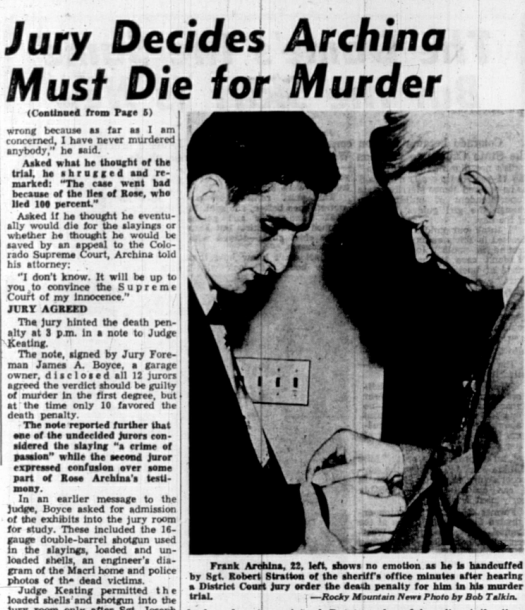
The Colorado Supreme Court intervened, vacated the verdict, and ordered a new trial for Archina in September 1957.
Another Trial, Different Results
Rose took the witness stand for a second time to testify against Archina. Her testimony was pivotal in sending him to death row back in 1955.
Rose again retold the tragic tale.
The defense spent the majority of the trial attempting to discredit her testimony because she is married to the accused. Despite their attempts, the judge ruled that she was a competent witness.
One key difference in the second trial was that the defense called the surprise witness to the stand. A former neighbor stepped forward and said that he was the first to enter the house following the shootings.
Robert Koch was in the backyard, hearing what he described as drum beats, and saw Rose escape to the outside.
He claimed to be the first to enter the house after the shooting and found Frank Macri Jr. in the kitchen, lying on his back, wounded.
He then found Frank Macri Sr. face down, took a pulse and said he was dead.
“Before I turned him over, he was lying on a gun — the gun seemed to be in the crook of his arm. I picked up the weapon and set it against the wall. It was a double-barreled shotgun.
He said he was there to hear semi-coherent words coming from Mary Archina.
“Don’t let them hurt him.” Koch quoted Mary’s words: “We made him do it. He wouldn’t hurt me.”
When cross-examined on why he didn’t step forward sooner, Koch said that he didn’t think it was necessary at the time, but after reading about how the police were puzzled why the elder Macri’s shotgun was leaning on the wall, he wanted to step forward.
This time, Frank Archina was found not guilty because of insanity.
Rose remained silent as the verdict was read aloud; neither she nor Steve Macri had anything to say after the end of the third trial.
Some members of the jury told the Rocky Mountain News they considered Archina mentally incompetent and felt that Archina had a second-grade education.
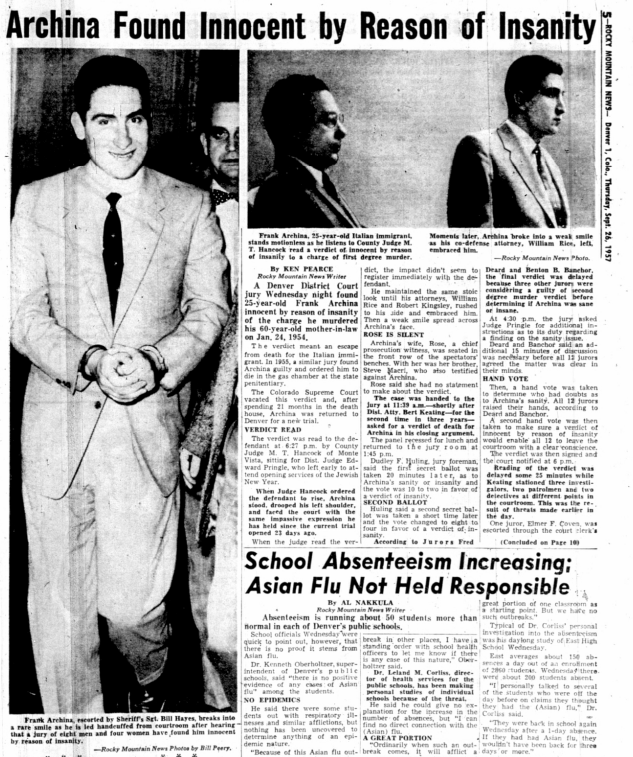
Two jurors interviewed by the Rocky Mountain News said they also could not believe all the testimony Rose gave.
Archina was sentenced to the State prison hospital in Pueblo for a mental health evaluation.
His time in Pueblo was short since the federal government petitioned to deport Archina back to Italy. His defense lawyers didn’t fight the order.
Days after the ruling, Denver Police and the DA’s office received several threats over the phone against the family of Detective Capt. Fred Zarnow, who was in charge of the Archina investigation. Two calls were also aimed at DA Bert Keating, who led the prosecution team.
One of the calls against the detective warned that Fred Jr. would not return home from his classes at South High School.
“We’ll take care of him,” the caller told Mrs. Zarnow. “If Zarnow doesn’t go to the judge and change his testimony.
Deportation and Ultimate Fate
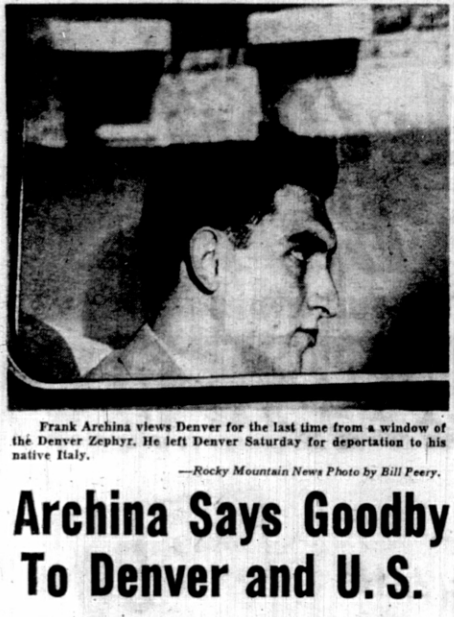
Archina was whisked out of Denver in April 1959, on a train, bound for his native land.
However, the story doesn’t end here, as he was arrested after stepping off a plane in Italy.
An Italian judge ordered that Archina be tried under the law, stating that Italian citizens could be brought to trial in Italy for crimes committed abroad, even if they have already been tried elsewhere.
In 1961, the Italian court convicted him of murdering Elizabeth and Mary Macri. He was also found guilty of attempting to murder Rose.
Archina was excused from Frank Sr. and Frank Jr.’s killings because they may have been armed, and the shootings were self-defense.
In July 1963, eight and a half years after the fateful day, Archina was released from an Italian prison. The chapter on one of Denver’s most sensational crimes faded with barely a whisper.