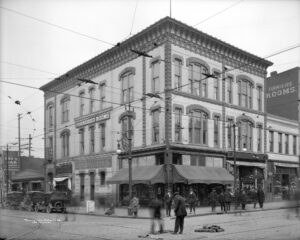
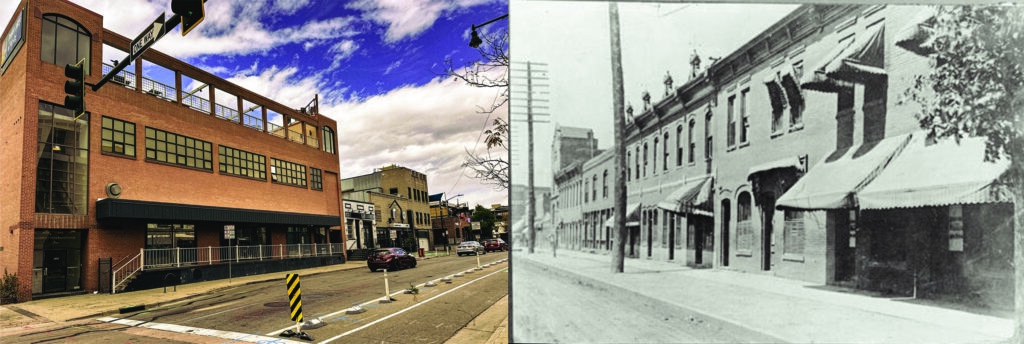

In Denver’s early days, Market Street was the wickedest road in town.
It was so notorious that it was renamed three times. At first it was known as McGaa Street, than Holladay Street, until the civic leaders settled on the Market, reflecting the “fresh produce” sold by vendors. Market is so notorious that even now the street is renamed Walnut Street north of 23rd since residents living on the street didn’t want have anything to do with Market street.
Regardless of name, Market was generally known as “The Row” for over 50 years, where civilized society dared not tread (at least officially). The area has been an entertainment district, but in the late 19th century, it offered a different kind of entertainment than it does now.
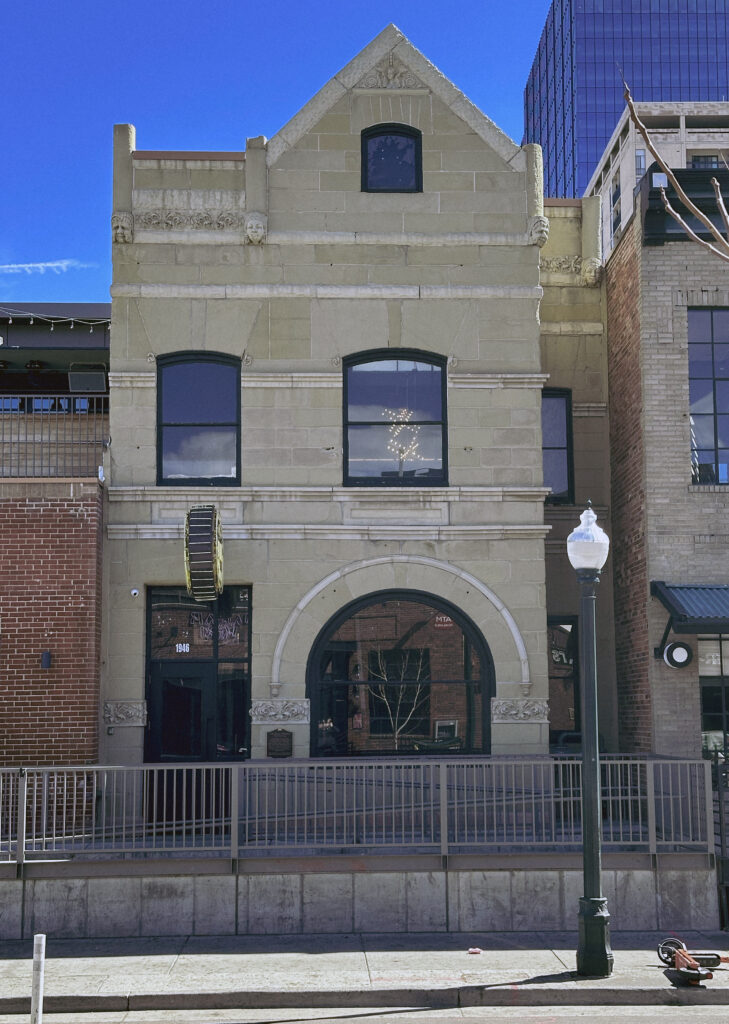
The buildings on Market ranged from simple three-room “cribs” attracting prospectors stumbling into town with pockets of gold dust to elaborate brothels for the same rich and powerful,, who admonished its existence, Market Street’s reputation as Denver’s red light district.
Fortunes were made and lost from the sweat and tears of women working in the flesh market to make ends meet. Women’s choices were limited in the Old West. Even with Colorado passing women’s suffrage legislation in 1893, options led to marriage, being a schoolmarm, or being a lady of ill repute.
Working on The Row was dangerous. Fear of robbery by a John was a constant threat unless women had the protection of a pimp or madam, who also exploited the conditions by a large cut and ensured a lifetime of servitude.
The life span for women working at The Row was not long. No hard statistics are available, but suicide was an unavoidable way of getting out of the business. But for three months in 1894, a hundred years before the Rockies made Coors Field their home in downtown Denver, the women of Market Street had to contend with a threat stalking them on The Row.
The Denver Strangler’s First Victim
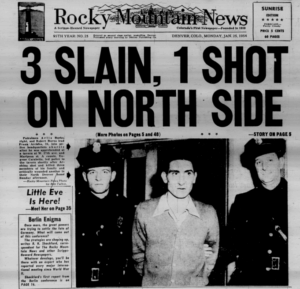
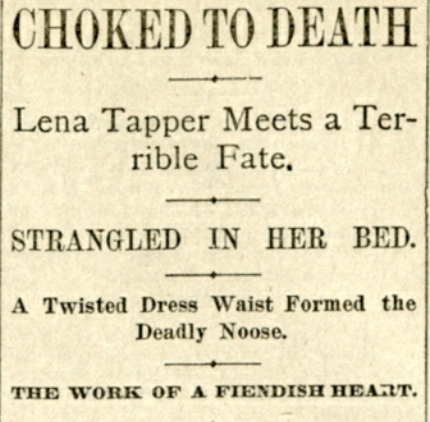
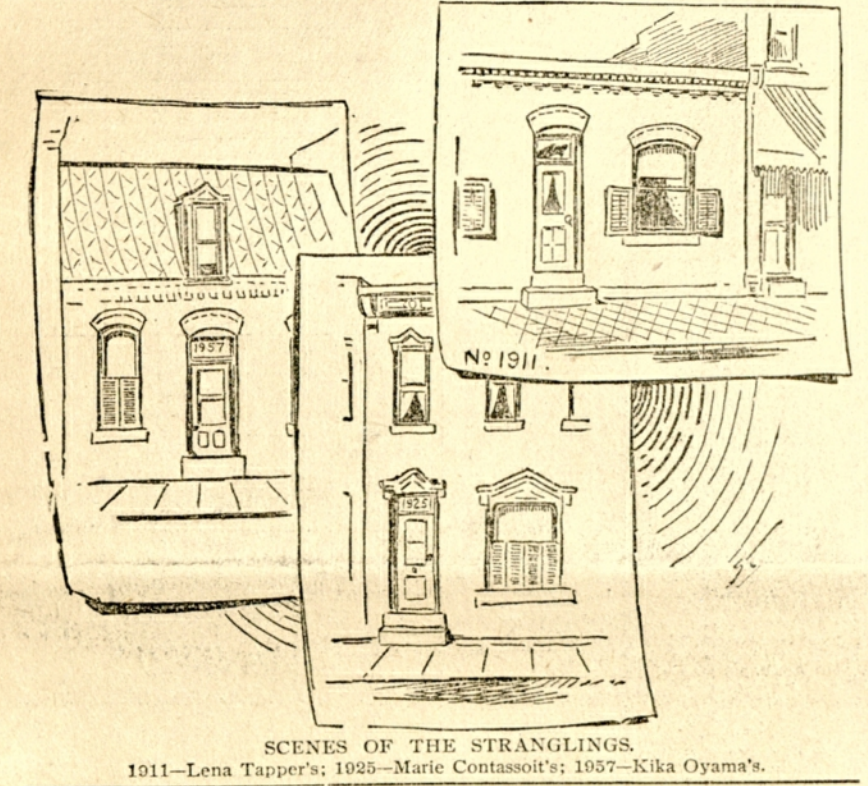
On September 3, local lady of the night Lena Tapper was found dead in her bedroorm at 1911 Market Street, strangled the night before, with a piece of her clothing tied around her throat to prevent any chance of resuscitation.
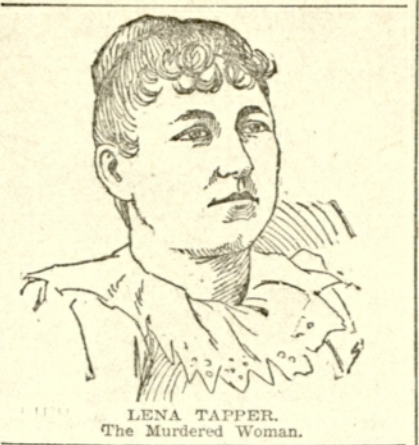
There were signs of a struggle between the killer and Lena, her face and head were unrecognizable due to the number ofblood and bruises. Denver police determined the assailant attacked her from behind, grasped Lena by the throat and slowly strangled her to death. She was struck with a heavy instrument over her right eye, crushing it and fracturing the skull.
She was discovered by Richard Demady, her longtime boyfriend who had been living together for years. Demady called the police and upon their arrival, he and his siblings, Edmond and Emilie Demady, were arrested soon after.
Accoding to the Rocky Mountain News, the Demady family looked to be players on The Row, with Edmond owning several properties between 19th and 20th and Market Street, including Lena’s crib on 1911 Market Street, and renting cribs to women so they could do their freelance work.
In a statement following his arrest, Richard Demady said he spent much of the morning running errands, attending a parade, and searching for a missing dog. He left to do his “chores” without checking in on Lena, and when he returned home to wake her up, he noticed the front door was unlocked. After groping his way through the dark room, he found her, now cold and lifeless, hand hanging off the bed.
On the morning of Tapper’s murder, an unidentified saloonkeeper said he saw a man leave her house around dawn. The witness claimed that he had been seen in the neighborhood several times. Some speculate that he had a grudge against Tapper because she robbed him and the mystery man was looking to even the score.
Another Murder on The Row
Eight weeks later, on October 28th, Denver Police Officer Tony Saunders went to check on his new wife, Marie Contassoit. The two had known each other for seven months but reportedly married for only a week.
As Saunders went downstairs from his second-floor bedroom, he opened Marie’s bedroom door and saw her lying across the bed in her nightclothes, her head against the wall and her feet hanging over.
Saunders called out to her but received no response. Nervous, he approached her, reaching out and gently jostling her feet; they were stiff and cold. His heart sank as he realized that his wife was dead.
Panicked, Saunders ran out of the house for help. In a Rocky Mountain News article that reported the murder, he found the front door unlocked with the key missing. When he hit the sidewalk, he blew his police whistle, and several officers walking the beat ran to 1925 Market Street, a few doors up from Lena’s strangulation.
What they found inside was shocking. Marie’s face was swollen and purple; her left eye was black; a slight discoloration was found near the nose on the left cheek, and another was found close to the left nostril. Her tongue was protruding, almost cut in half, with splatters of blood outside of her nose.
The officers scoured the scene for clues. They found a piece of rope lying close to Marie’s belongings. They also found that Marie’s stockings looked as if they had been pulled off her legs quickly. A shiny quarter lay on the carpet, not far from the bed.
The most apparent evidence of strangulation came when the surgeon found several blackish-red patches in the windpipe area. Nervous Denverites imagined White Chapel’s Jack the Ripper wandering the Row.
An army of police officers and detectives converged on the scene. They canvassed the area, desperate to solve the case before The Strangler struck again. Tensions were high on The Row, and Residents of Market Street slept with pistols under their pillows. Desperate to appear to be progressing, the police began making arrests.
The first suspect they approached was Telluride miner John Callaghan, since he had a run-in a few days earlier,, accusing Marie of stealing $160, but no formal charges were brought against her.
Soon after, two others were taken to the city jail to join Callaghan. Charles Chaloup and Richard Demady were both picked up and charged with vagrancy and suspicion. Charles Chaloup was under suspicion simply because he lived with Marie’s sister.
While Chaloup’s connection to the case was thin at best, interest in Richard Demady stemmed from his status as the lead suspect in another murder.
One More Victim
On November 13th, the third victim, Kika Oyama, was found in her home at 1957 Market Street. The 19-year-old Japanese woman arrived in Denver from Chicago and had been there for only about a year.
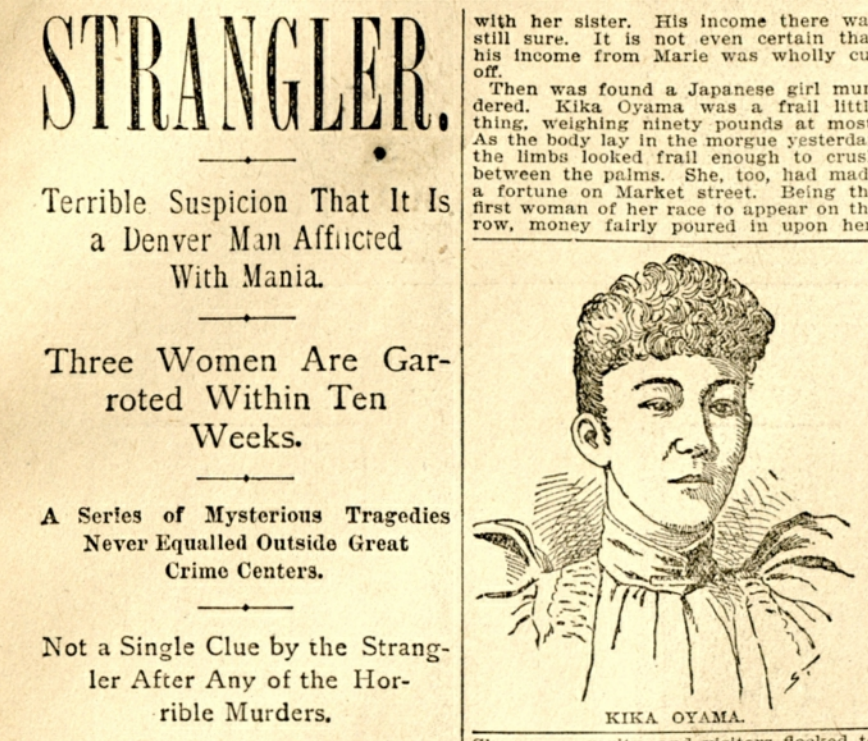
When the officers arrived on the scene, her body was still warm. A rough towel was near her on the bed, with the cloth’s marks on her neck. The front door was locked, but the doors leading into the backyard were wide open. Detectives found freshly made footprints in the alley pointing to 19th Street.
Kikda was last seen by her window a few hours before she was found dead by beat officers. They were inquiring about whether she arranged for the release of three Japanese men arrested for vagrancy at a nearby bar, and she said that she paid a saloonkeeper to bond them out.
Rocky reported that the few traces of evidence included a partially-burnt cigar found in her room and minor indications someone was trying to break into her trunk.
The police rounded up eight suspects, including Kika’s roommate, Ina Oyama (no relation), who claimed to have seen her alive hours before the killing and returned to the house late at night to discover her dead.
Search for the Killer
While the Denver police were good at rounding up suspects from salons near Market, nothing came from it.
The frenzy was at a fever pitch along Market Street. Those living in the neighborhood were on a heightened sense of alert, even more than with the profession’s demands.
One woman shared her fears with a reporter: “Only last night,” said one of the terrified women yesterday, “a man says ‘Where do you keep your money? You must make lots,’ and started to see where I would put it. “Take care,” I told him. “My dog will seize you by the throat.” So he stopped. I believe some men are so hard up they would kill a woman for $5. Only for my dog, I would not live here any longer.”
Some progress was made in Marie Contassot’s case in January 1895, when two Frenchmen were arrested for her murder. Her husband, Officer Saunders, was one of the arresting officers in the case, though any closure he may have felt from the arrest was short-lived.
Reports of the arrest were beamed via telegraph to the West and East Coast newspapers, The New York Times, which ran a blurb, but it seems the case stalled as the two Frenchmen were never tried for the murder.
The best prospect for any kind of prosecution was in convicting Richard Demady of murder.
Demady’s day in court came in late May 1895, but the evidence presented during the 18-day trial was primarily circumstantial.
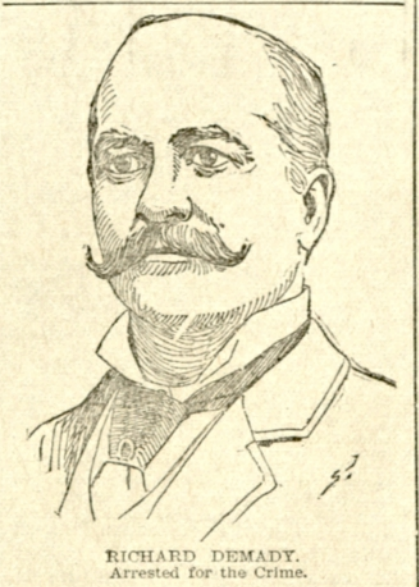
One surprise witness, a young black man named Jesse Crow, testified that when he was walking out of his mother’s house across from Lena’s dwelling, he saw Demady walk out of Lena’s house with a bundle of clothes under his arm the morning after the murder.
Once the case was turned over to the jury it only took a three-hour deliberation, the jury found Demady not guilty of killing Lena Tapper. With that, the embers of bringing anyone connected to any of the three cases were put out.
Some speculated that Demady paid off the jury, though no evidence exists to support it. After one of the more sensational and expensive trials for Denver, at that time, came back with a verdict of Not Guilty, the Denver Police had no other suspects for the three strangled on The Row.
Daily life on The Row eventually returned to normal, at least average for that part of town and the anxiety stirred by the Denver Strangler murders faded into folklore status. Three years later, a “fourth” victim was tied to the string of killings.
A Fourth Victim?
On October 8, 1898, Mrs. Julius Voight was found dead in her apartment at 2020 Champa, five blocks away from Market. She was found strangled, eyes bulging out of her socket, her tongue stuck far out, black and swollen, and the veins on her face showed in black lines of clotted blood under the blue skin.
Voight’s killer also tied a knot in the towel around her neck, much like the fate of Lena Tapper.
Voight’s connection to the stranger cases was an odd one. During the height of the 1894 murders, Voight was brought in as a police consultant for the cases. She claimed that her clairvoyant powers revealed the Denver Stranger to her. Even though she never delivered a suspect to the police, she met the same grisly fate as the three young women on Market Street.
The connection between each of these cases is loosely tied, but considering the method and locations of each murder warrants speculation. The killers
One More Theory
One more theory I’ve pieced together from my research concerns the Rocky Mountain News story about jury tampering. It’s not too crazy to think Demandy had the means to use the money to get away with murder, but what if it went beyond that?
What if he or his siblings killed Marie and Kika to help create hysteria that a serial killer was roaming the Row? Other damning evidence includes pillowcases buried in a hamper with blood and evidence of blood on clothes that belonged to him.
Circumstantial evidence from 120 years ago wouldn’t be enough to prove guilt today, but what about Demady’s family business? Richard Demady could afford a $5,000 bond, roughly $133,000 today.
Edmond owned several properties, and their sister was a noted Madam on The Row, so it’s easy to point out that they had a hand in the flesh business on Market Street.
Another questionable piece of evidence was printed in the Rocky when it was revealed that Demady had correspondence with another woman in Albuquerque, and mentioned that he might be moving away from Denver.
Demady eventually married his Albuquerque penpal, but eventually divorced her in 1902.
For some, Demady’s connection to the murders never faded away, as with Deputy Chief John J. Layden, who was featured in a 1914 story celebrating his 25th anniversary with the Denver Police Department. He recalled several unsolved cases, including the murder of the three women on the Row.
“The murder of Marie Contasstat, a woman of the underworld, was one of the most interesting cases I ever handled. She was killed in her room on Market Street because she was to be a witness at the Lena Tapper murder trial.”