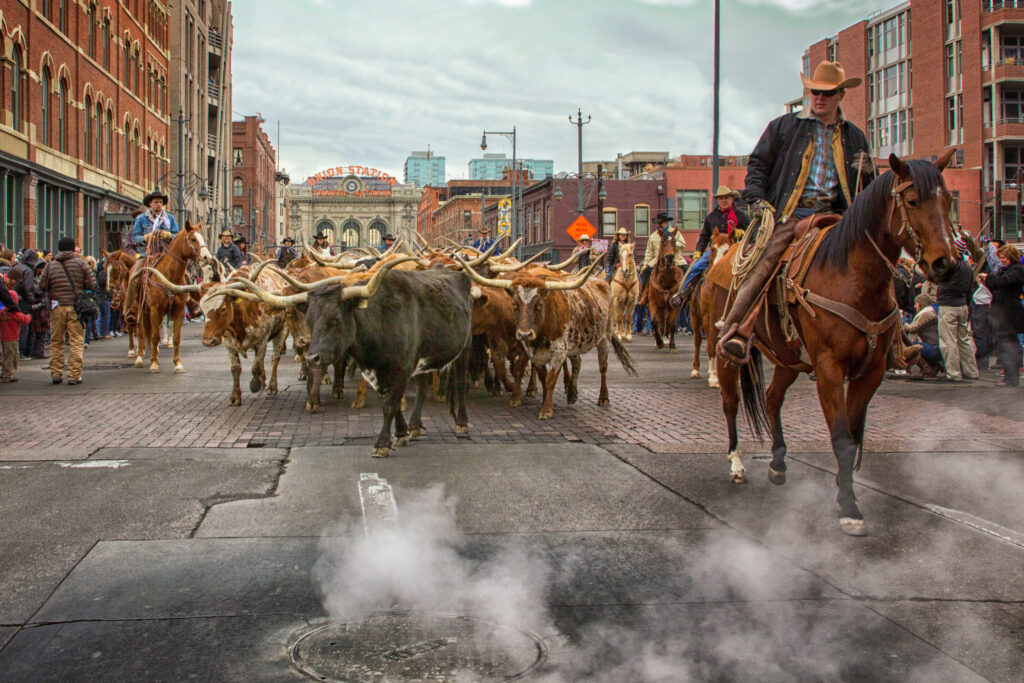

As much as Denver tries to shed its cowtown heritage, January reminds us that Denver is the destination for many a cowboy and rancher. The National Western Stock Show starts this week, with a parade down 17th Street, mutton busting, Mexican rodeos, and many other activities for one of the largest conventions in the livestock and agriculture industry.
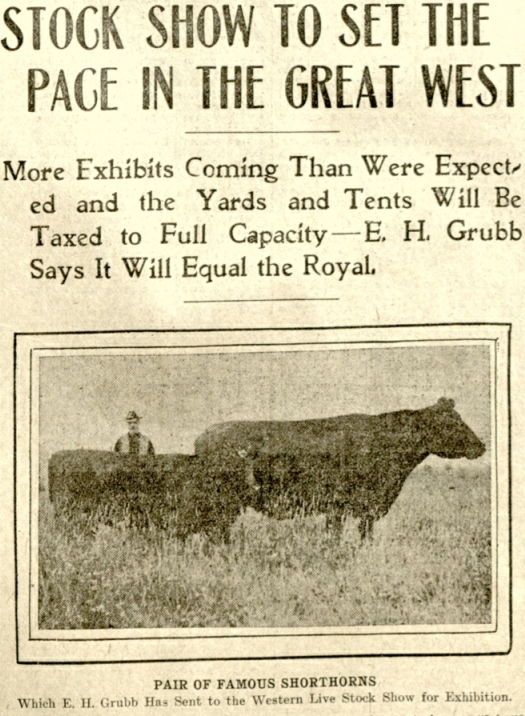
There was a time when civic leaders and businesses preferred to be called a cowtown. The city worked to bring a stock show to town to support the agricultural industry and to make the Mile High City a destination for livestock.
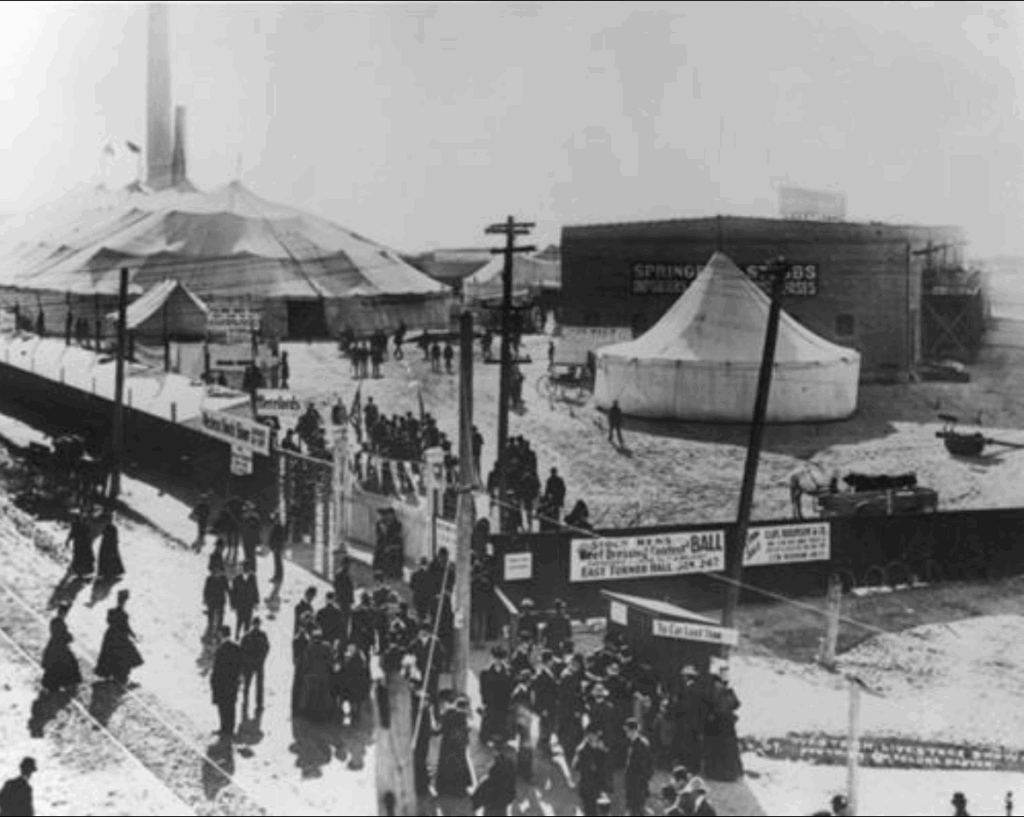
The first stock show ran from January 28 to February 2, 1906, and organizers called it a success and began planning for next year’s show. The first Western Live Stock Show was held at the Union stockyards and included 336 entries and nearly 100 cars of stock.
The event was a consolidation of the American Stockgrowers and the National Live Stock Association.
The first stock show parade was held on January 31, 1906, on “Denver Day,” a day when business was halted around town so Denverites could visit the stock show held at the Union Stock Yards in the Globeville neighborhood. The exact parade route wasn’t printed, but all prize winners participated. The two tents holding the exhibits were rolled up, so more than 25,000 visitors could get a better view of what was going on under the big tops.
“Private rigs of every description, from sulkies to forty-horsepower motor cars, were lined up around the yard in front of the Live Stock Exchange building, and instead of being composed largely of stockmen, ranchers, and commission men, the throng was composed of women and children to a degree in excess of that noticed at any previous day of the show.” The Rocky Mount News wrote.
The first stock show grand champion was a 17-month-old steer sold to a prominent Denver tucher, James Douglas Miller, who paid 33 cents per pound for the 1,150-pound animal, totalling $379.50.
Miller had been living in Denver since 1888 and had opened several butcher shops in North Denver and downtown, on 15th and Arapahoe.
Unfortunately, tragedy struck Miller, who died suddenly a few days following the stock show from acute gastritis in his Northwest Denver home on 2555 W. 36th Ave.
The 35-year-old meat dealer left behind his wife, two children, and an estate worth $29,466.
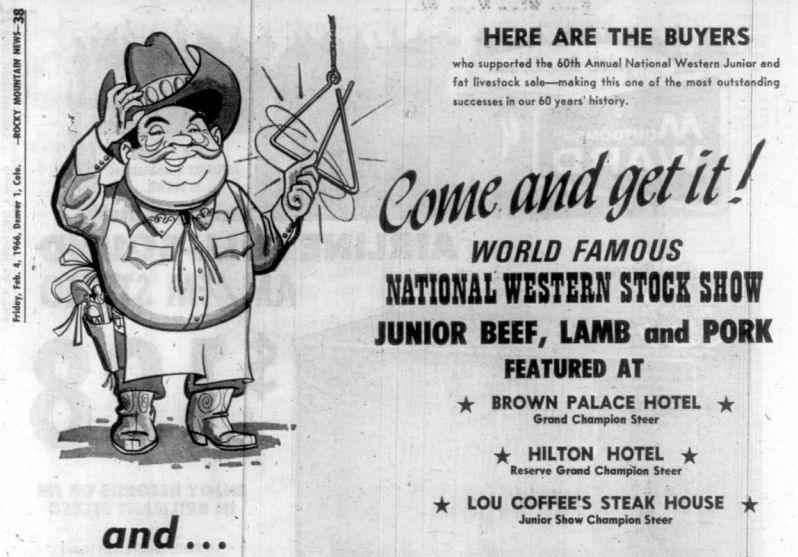
The Brown Palace Hotel is a historic symbol of opulence for travelers and shares a history with the Stock Show. The hotel has been home to many conferences and events tied to the Stock Show.
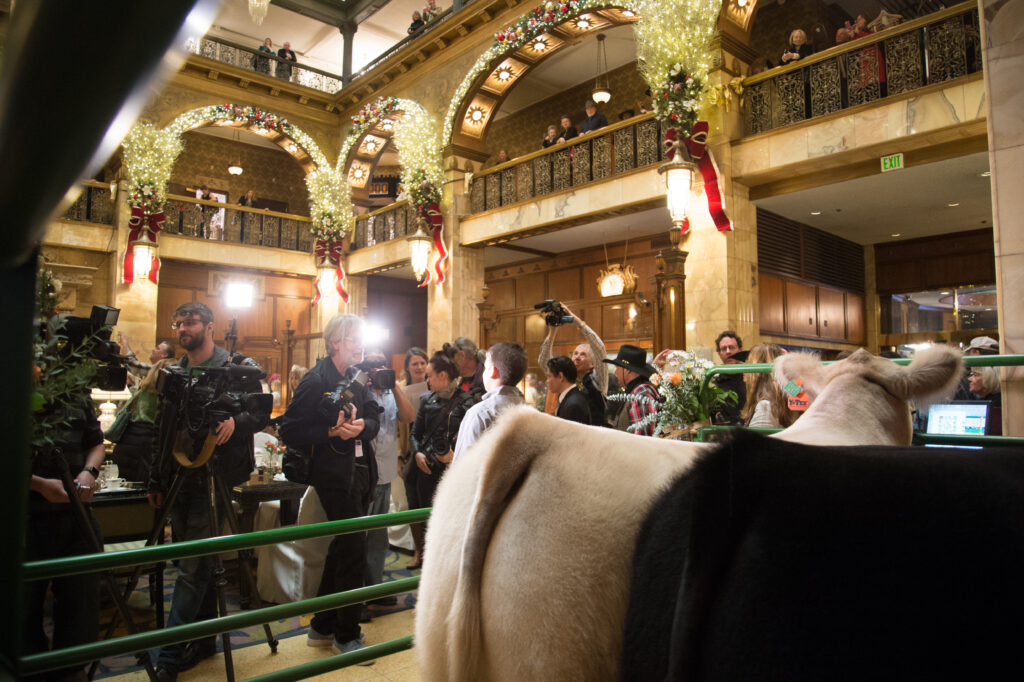
During Stock Show season, some celebrities who hung their hats at the Stock Show walked in on four hooves. The Brown Palace lobby has hosted the Stock Show’s grand champion steer for 80 years.
Other hotels are no strangers to displaying National Western prize-winning animals, like the old Denver Hilton, which would also host grand champions for visitors to view.
Grand champions who were displayed at the Bronw Palace include the likes of High Voltage, Red Meat, Whopper, Quinine, Catch-It-Calf, Thunderbolt, Gold Dust, Big Red, Joe Montana, Castor, among many others.
Other companies that frequently purchased Stock Show champions included other former hotels, and also King Soopers/Kroger had their bidding hands up for livestock.
Anyone who has lived in the Mile High City for a few years would also be aware of the phrase “stock show weather,” which describes the frigid temperatures Denver experiences. The phrase was found in news articles as far back as 1914, but became more common starting in 1938.
The National Western Stock Show was cancelled twice in its long history. The first was in 1915 due to concern over rampant foot-and-mouth disease, and the other was in 2001 due to the COVID pandemic.
Big Mac crisis of 1972
One of the more controversial moments in Stock Show history was the coronation of a 1,200-pound black Angus steer named Big Mac, which was crowned the grand champion.
The steer was raised by Rex Miller, 16, from Alta, Iowa, who won the junior championship, earning him the chance to compete against other open-class winders for the grand prize.
Before the junior show champion judging, two former 4-H Club members filed a protest about Big Mac, who claimed he was not sired by an Angus and had been shown previously.
McDonald’s Systems Hamburgers paid $14,250 at auction for the grand champion steer
But the story of Big Mac’s true pedigree came to light during the investigation, when a white coat overtook the jet-black fur.
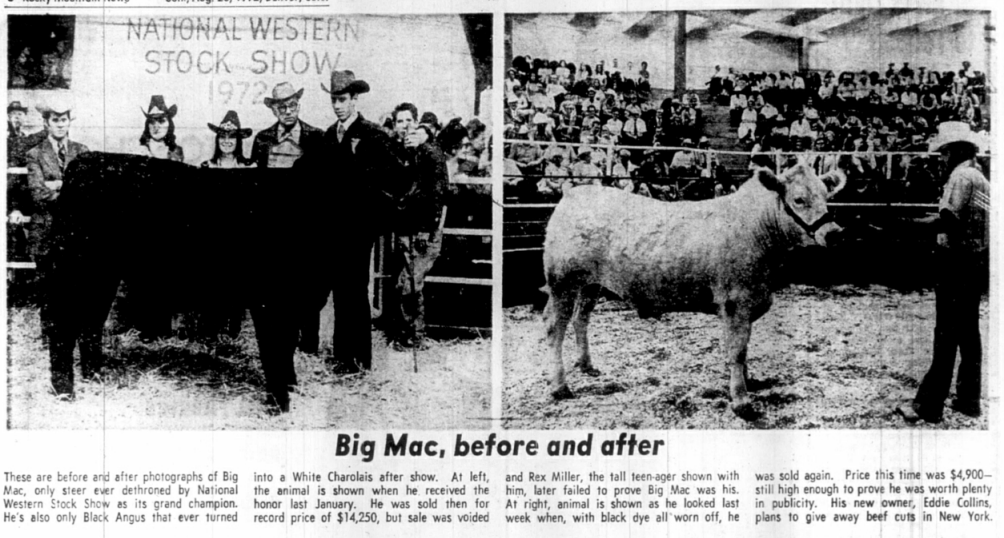
National Western Stock Show officials determined that Big Mac was ineligible because he’s not an Angus, has been shown previously in a major show, was not owned by the Millers for the minimum period of time, and was not a bona fide 4-H or FFA project. The National Western Committee determined that Big Mac was a White Charolais.
An Angus named Old Dakota was named the new grand champion steer, the reserve champion, and was sold to the Brown Palace Hotel for $5,600.
The father of the new grand champion told the Rocky Mountain News that he had doubts about Big Mac during the Stock Show.
“He seemed too thick to be an Angus. Also, he had horns, which are impossible in an Angus. We didn’t protest or complain, though. We had confidence that the National Western would make a complete investigation, and they’ve done a great job.”
McDonald’s also sued to recover the $14,250 it paid at auction. The court declared the steer an “estray animal” under Colorado law and terminated the lawsuit.
An Iowa cattleman broadcaster paid nearly $5,000 for the dethroned grand champion.