

One person’s faith can easily become another’s hoax, but what happens when this debate is brought into a courtroom?
The question led to legal action on April 17, 1946, when 46-year-old Martina Cordova was arrested for practicing witchcraft illegally.
The clairvoyance statute stems from a state measure passed in 1921, which made fortunetelling, palmistry, tarot reading, astrology, and other forms of divination illegal in Colorado.
Denver jump-started the push to make clairvoyancy illegal by revoking licenses for fortunetellers and psychics in 1913, effectively driving these professions out of the city limits.
At the time, Denver’s witch trial was compared to what happened in Salem, Mass., in the 1690s. But it is more akin to cases in the Southwest, with some witch trials taking place as recently as the late 1800s in New Mexico.
Most Latino children grew up in neighborhoods hearing tales about brujas and avoiding crossing them out of fear of supernatural retaliation. But when superstition can’t protect you from reprisal, former customers of Cordova turned to the Denver authorities.
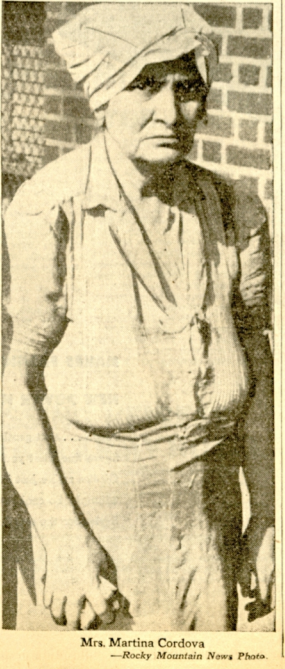
The charges of practicing clairvoyance and practicing medicine illegally were filed against Cordova by Denver Deputy District Attorney James N. Sabin as an outgrowth of complaints that she had been practicing witchcraft for fees.
More specifically the charges against Cordova was that she “did unlawfully practice and exercise the vocation and calling of clairvoyancy, palmistry, mesmerism, fortune-telling, astrology, seership, and like crafty science, readings, sittings and exhibition of a like character for a person to-wit: Delores Comps and did make charge and accept a fee therefore, to-wit: the sum of $25.00 from the aforesaid Delores Comps.”
The complaints were made by people who claimed to have been bilked by Cordova’s witchcraft practices.
When they arrested Cordova, they found a collection of peculiar candles, two jars filled with mysterious rank-smelling fluid.
The police also found letters from all over Colorado and the Rocky Mountain region, most of them in Spanish. Some of the translated pieces were appeals from people requesting that hexes be removed.
Cordova was held in jail under a $1,000 bond, but her detainment was complicated due to a 2-year-old child who was under her care. The child was handed over to the state humane bureau while they investigated the whereabouts of her parents. It was reported that the mother passed away and Martina was watching over her.
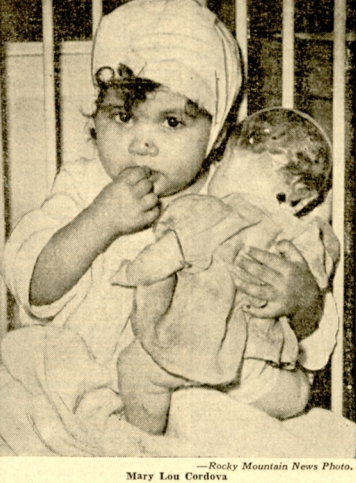
However, San Antonio authorities informed Humphreys that the address they were given for the mother’s whereabouts was fake and found no trace of her.
Trial Day
Reports described the carnival-like atmosphere of the trial when it started on June 13, 1946.
The trial was presided over by Justice David W. Oyler, and on June 14, 1946, his daughter, Margaret, had the unique perspective of witnessing the trial from the court’s jury box, as there was no jury seated for the case. Six years later, she wrote a detailed account of the trial’s proceedings for Western Folklore magazine.
“Before the court opened, the constable came in with three large jars of queer-looking liquids labeled A, B, and C and a big bag of red and black candles,” Oyler wrote.
The state’s first witness, Felix Martinez, spoke only Spanish. He said that he lived with Martina for six months, receiving treatment for his illness. He paid $60 for the treatment and was instructed to drink one of the elixirs once a day to get rid of the hex that was placed upon him.
The second witness was Delores Comps, who came to Cordova because her son was engaged to a girl she disapproved of. She alleged that Cordova read her cards and was told her son was under the influence of a love potion and he either had to marry the girl or go crazy. She testified that Cordova could “unhex” her son for the simple fee of $100.
She was also told to take a black candle and burn it in the alley behind their house at midnight. Dolores paid $25 and said that if the unhexing worked, she would pay $125. But the plan did not go as expected because Comps’ son came home one night and said that he had married the girl the mother did not like.
The judge asked if Comps asked for her money back or to pay the rest of the amount owed. She replied no to both questions.
Margaret wrote that the third witness, Eva Ramirez, had little to say except that she was also treated for a hex.
Following the lunch recess, the state continued its case by questioning Dr. Frances McConnell, the city pathologist, about the contents of the jar; however, the pathologist could not be considered an expert on the chemical composition of the elixir. There was some confusion on the witness stand, which prompted the judge to call for a recess and bring the attorneys into his chambers.
This is where Margaret became part of the story when she was called into the judge’s chamber as an unprejudiced expert to determine if the chemicals were poisonous. She stated that, except for a few substances, the jars were harmless.
The defense attorney returned to the courtroom to confirm with the pathologist that the chemicals were harmless.
The defense’s only witness was Martina Cordova herself. When brought to the stand, she denied all the charges and stated that the real reason Cordova was charged was due to a quarrel between Cordova and Comps over a restaurant a year before Cordova’s arrest.
Judge Oyler postponed his decision on the case for two weeks and ordered the plaintiff’s lawyers to present the court with relevant laws concerning the charge of practicing medicine without a license. The main issue was to determine whether Cordova administered potions to cure patients’ physical ailments or to remove alleged hexes.
On June 28, 1946, Martina Corodova was fined $150 plus $15 costs on the charge of practicing clairvoyance. Judge Oyler dismissed the charge of practicing medicine without a license, stating that the witnesses did not say they were suffering from diseases or that she had treated them for physical conditions.
Martina faded away from the public spotlight and sensational headlines, passing away in July 1961. She was survived by her daughter, Mary Lou Trujillo, and one grandson.


